 Droughts have had devastating effects on our operation. While 50% of the Southern Plains are not currently in a drought, the CPC-IRI Forecast has increased the likelihood of having a Niña season by the end of this summer until the end of the 2025 winter, which is correlated with lower rainfall in our area. To prepare our business for the future and ensure long-term sustainability, we must have and implement a drought management plan.
Building a Drought Management Plan
Droughts can have a devastating effect on our operations, from a productive to an economic point of view. The best time to make our drought plan is before there is one. Some of us were blessed with plenty of rain this spring and so far this summer. However, according to the USDA drought monitor, many other places in the Southern Plains remain in drought status. Around 50% of this area is experiencing some drought (Figure 1). It is not too soon to dust out those drought management plans, even if we have plenty of moisture.
Figure 1. U.S. Drought Monitor. Southern Plains Region.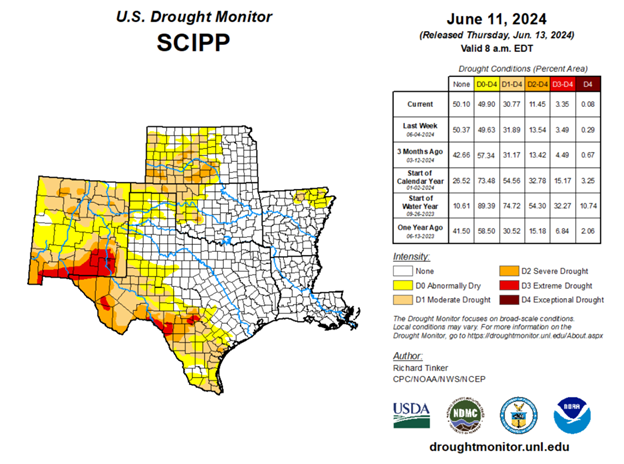
The risk of being in another drought by the end of this summer is increasing with probabilities of day after day. During this last month, the CPC-IRI Forecast of the Niño/Southern Oscillation has increased the likelihood of being in a Niña season by the end of this summer until the end of 2025 winter (Graph 1). Remember that a Niña is correlated with a lower rainfall in our area. The sooner we prepare for it, the higher our chances of successfully implementing a drought management plan, saving costs, and having a solid business.
Graph 1. CPC-IRI Official Probabilistic ENSO Forecast. 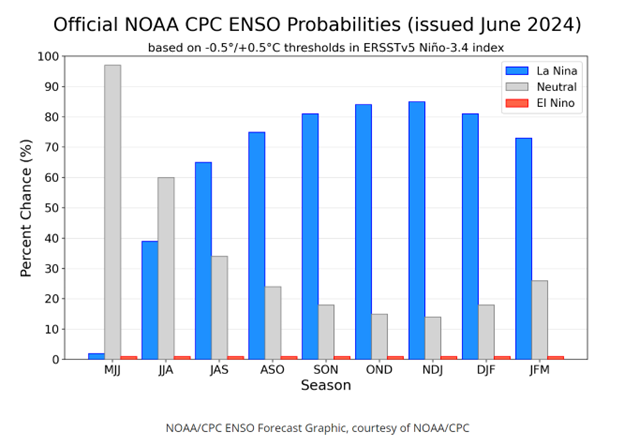
The economic impact of drought on ranchers is substantial. It often leads to reduced income, increased costs, and long-term damage to our pastures. Prolonged drought has devastating effects that can last many years.
As ranchers, we are usually faced with the uncertainty of when a drought might end, challenging our decision-making, such as determining optimal timing for reducing livestock numbers, identifying which animals to sell first, and navigating the potential fluctuations in market prices and feed availability.
Drought Management Plan
A drought management plan should contemplate more than one strategy that will create synergies and mitigate adverse economic impacts. It should also consider future restocking strategies given the business’s financial position, long-term profitability, cash flow, the years it will take to rebuild livestock equity lost during the drought, and other productive variables such as forage productivity, genetics, or leasing alternatives.
Reduced income and elevated costs are common consequences of drought. Ranchers frequently face lower livestock sales, decreased gains, and higher feed and vet expenses. Furthermore, losing herd genetics from destocking can be a significant setback for ranchers who have dedicated years to build their herds.
Building flexibility into the livestock herd by maintaining a flexible herd composition and using light to moderate stocking rates can be beneficial in reducing the severity of droughts. A carefully planned system for reducing animal numbers and a comprehensive understanding of livestock demand and existing forage conditions and supplies can play a key role in mitigating the severity of drought effects. Additionally, the decision to destock the herd or relocate cattle to another facility is also a viable measure to reduce the economic impact of drought.
Furthermore, the United States Department of Agriculture (USDA) offers various programs and resources to assist ranchers in mitigating the economic impacts of drought. These programs include assistance with livestock feed programs, emergency loans, conservation and stewardship programs, and risk management programs, which can support ranchers during challenging times. USDA’s Pasture, Rangeland, and Forage Insurance (PRF) is an essential tool that can be implemented in many cases. PRF showed a positive net benefit in many cases. Still, most importantly, it generated significant payments in drought years when it was needed most.
Conclusion
By implementing these comprehensive strategies and accessing relevant USDA programs, ranchers can effectively reduce the economic impacts of drought and build resilience within their operations. Through meticulous management of forage, livestock, stocking rates, and stock reduction plans, ranchers can mitigate the adverse economic effects of drought and ensure the long-term sustainability and profitability of their operations.
At the District 3 Agriculture Economics Website (https://vernon.tamu.edu/extension-projects/d3-agricultural-economics/), you will find the Drought Management and Restocking Options Decision Aids to help you analyze the impact of each alternative in your operation. This model will help you measure the short-term (1 year) and long-term production and economic impact.
Unfortunately, droughts always have a negative effect on our businesses. Waiting for it to rain and solve our problems has not always been the best solution. We must prepare ourselves to weather the drought. These types of tools will help you prepare your business, given your production data, financial position, experience, and future expectations.