• Skip to primary navigation
  • Skip to main content
  • Skip to primary sidebar
  • Texas A&M Forest Service
  • Texas A&M Veterinary Medical Diagnostics Laboratory
  • Texas A&M AgriLife Extension Service
  • Texas A&M AgriLife Research
  • Texas A&M College of Agrculture and Life Sciences
Sheep And Goats
Sheep And GoatsStaying Up-to-Date on Sheep and Goats
  • Menu
  • Welcome
  • Events
  • Blog

Reid’s Ram-blings: January 2020

January 14, 2020 by andyherring

Customers Want to Know More

Undoubtedly, throughout your involvement in agriculture, you have heard buzz words such as “sustainability”, “animal welfare”, and “predator friendly.” In fact, in today’s jump-to-conclusions world it is probably more than likely you haven’t been able to escape these themes in nearly everything you read or watch on TV.

To me, this is largely the result of a public who is uninformed about animal agriculture and has developed an opinion based on theoretical concepts and is limited in real-world application. Beneath the surface of these “this-is-how-you-should-do-it” declarations, we need to realize that folks want to know where their food and fiber is coming from and how it is produced. Unless we deliver that information first-hand, consumers will continue to seek information from a wide variety of outside sources. This is where Quality Assurance Program come in.

What are quality assurance programs? These programs are essentially a set of production and processing guidelines. When followed, a product can receive the program’s stamp of approval. This information can then be displayed at the retail level and folks can feel good knowing that they are buying something that was raised a certain way.

Man with Lambs

In the next year, I challenge you all to do some research into quality assurance programs and then to act on that information learned. Make a decision about whether to participate in a quality assurance program. If you choose not to participate, discuss your lack of participation with others in the industry to bring awareness of the need for small ruminant quality assurance program that fits your style of ranching.

These are touchy issues because most programs have a strict policy, which infers that there are right and wrong ways to do things. But most all long-time ranchers know that the real world isn’t “black and white” but rather “shades of gray.” So, how do we develop programs that allow good stewards the freedom to manage for the betterment of the people, animal, and natural resources?

To answer this, I think we must focus on why we need quality assurance programs. Ultimately, quality assurance programs exist to ensure consumer confidence in your product and how it is produced. I have had the great pleasure of meeting people from a wide variety of places and backgrounds. In my assessment, most consumers in the US would admire what you do at the ranch and they’d agree with 95% of what you do after you explain to them why it is necessary. However, if you watch the news, you don’t see the silent majority. You only hear from the highly vocal minority.

In my assessment, many quality assurance programs that are being promoted to American sheep producers are designed to please the minority, not the majority. Some ranchers may be able to accommodate the requirements of these strict assurance programs and benefit from the premiums (if they exist) associated with these programs. However, that doesn’t mean that there isn’t a need for more programs that are better aligned with the majority of ranchers and consumers.

It appears that many of the companies who market your products are looking for quality assurance programs to partner with because they don’t want to manage it themselves. If the only program that exist are quite restrictive, they are then forced to work with them. This puts our industry at risk if producers have to comply with a strict quality assurance program because the company marketing our product is our only outlet and their only assurance program is a strict one. Unfortunately, for mohair producers, this might become a reality.

Procrastination has served the sheep and goat industry well on a number of things. For instance, scientific research funded by other livestock species or sheep industries overseas has provided us answers to questions without the cost of doing it. But procrastinating on developing common sense quality assurance programs that are recognized by consumers may end up biting us in the rear.

We all believe that what we are doing is “sustainable” and “ethical”, but we need to realize there is a portion of our customers that do not think that because we haven’t bothered to show or tell them. In contrast, many of them think this because we have allowed someone else to inform them of what “good animal husbandry” is. Common sense quality assurance programs are a great first step to help us share our story of sustainable sheep and goat production.

Here is a short list of assurance programs to help get your research started. We are not promoting these programs. This list is simply to make you aware of their existence, nor is this an exhaustive list:

Available in the U.S.:
https://sheepusa.org/resources-publications-ssqa
https://responsiblewool.org

Front Page 202012

Overseas Sheep Programs:

Homepage


https://www.rmpp.co.nz/page/nz-farm-assurance/
https://www.agriwebb.com/farmaccreditation

To provide feedback on this article or request topics for future articles, contact me at reid.redden@ag.tamu.edu or 325-657-7324. For general questions about sheep and goats, contact your local Texas A&M AgriLife Extension Service county office. If they can’t answer your question, they have access to someone who can.

Filed Under: Uncategorized

Reid’s Ram-blings: December 2019

December 13, 2019 by andyherring

Wool: Beyond the Stereotype

This edition of Reid’s Ram-blings was composed by Jake Thorne, Texas A&M AgriLife Extension Associate. Jake has been a contributing editor to this column over the past year and is a valued asset to the sheep and goat Extension team at the San Angelo center. Enjoy!

Mr. Jake Thorne

Mr. Jake Thorne

Wool is the best kept secret in the world of natural fibers. It’s more expensive than cotton, not as prominent as leather, and not as trendy as hemp… but in my opinion, it is the premier fabric on the planet!

It may not even be fair to claim wool as a secret, as it can be argued that wool is the original fiber used for clothing. However, only recently has wool started to shed its stereotype as a winter-only sweater with a make-ya-squirm itch factor of 10.

Thanks to improved genetics and super-wash technology, developed in Australia and popularized in the last decade, that removes the “prickle” caused by wool scales and sharp fiber ends, wool is popping up as a next-to-skin apparel item for all four seasons. You’ll find it under heavy down jackets on Mt. Everest, in a camo pattern in the woods this fall, as a reflection protectant around a fisherman’s neck in Belize, and of course, on millions of feet as both socks and shoes.

It doesn’t stink. Its absorbent. It’s fire retardant. Its biodegradable in 6-months. And most importantly, it keeps your body temperature in a comfortable range… not too cool or warm. #woolcandoitall.

The point of my heavily biased promotional statement is to lead into the fact that Christmas is right around the corner and I hope you look for American wool products for your loved ones. Save the polyester for the white-elephant exchanges!

Admittedly, the majority of the wool we grow in America gets quickly snatched up by China (in the absence of trade wars), but here and there, a few apparel companies have turned their eyes to the homeland to find a domestically sourced product, and a few sheep outfits and off-the-farm-buyers have stepped up to the plate as providers. If you are interested in purchasing an item that will last forever, can be worn year round, and is 100% made in the USA, I encourage you check out the following website; https://www.americanwool.org/

With that said, wool doesn’t just happen. It takes tremendous efforts on the part of farmers, ranchers, shearers, buyers, and marketers to grow, harvest, and sell this unparalleled fiber. Truly, if it was easy, everybody would do it and wool would be cheap. However, it takes dedication to ensure the well-being of the sheep who grow it and to care of for the fiber itself, all the way from sheep to shelf.

The production of wool in the United States is truly an inspirational story that the public, who is increasingly curious about where their food and clothes come from, are falling in love with. There is history in the wool business, there is beauty in the areas it is grown, there is magic in the way it performs as a fiber, and it is the true definition of sustainability.

In Texas especially, we are fortunate to have mohair and angora goats as a major component of our fiber industry as well. Some would say that sheep turning grass into wool is a superpower, but I would argue that goats are more impressive, they grow hair living off cedar and rocks!

Here in the San Angelo office, we make it a point to promote wool and mohair in every way we can, and that mostly comes in the form of supporting those who produce it. Besides relaying the latest scientific research, we also annually hold a shearing course in early January. To steal the name from our sheep friends up north, we should really rename the event a “wool-harvesting” school.

Students will attend from across the state and country to learn the ropes of becoming a shearer. They come with a sense of curiosity about the practice and leave with sore muscles, a belly full of lamb, a new skill, and most of all, an appreciation for what it takes to play a part in producing the greatest fiber in the world. We need you to encourage young people to participate and learn this skill, which requires strength, endurance, and perseverance – traits that most all ranch kids already embody.

In closing, I want to circle back to wool as a Christmas gift. I continuously mentioned it as a clothing item, but did you know there are wool surfboards? How about wool band-aids? I bet not. So, when Santa is furiously looking for last minute ideas, let him in on the secret that is American wool. Actually, let’s face it, that red robe alone doesn’t keep him warm all night traveling through frigid conditions … I bet he already knows!

To provide feedback on this article or request topics for future articles, contact me at reid.redden@ag.tamu.edu or 325-657-7324. For general questions about sheep and goats, contact your local Texas A&M AgriLife Extension Service county office. If they can’t answer your question, they have access to someone who can.

Filed Under: Uncategorized

Reid’s Ram-blings: November 2019

November 1, 2019 by andyherring

Focus on What You Can Control

Every wonder why there aren’t too many “type A” people in the sheep and goat industry? You know, the type of folks who have to control every segment of their lives. As if the weather, markets, and government weren’t enough, multitudes of dogs, kids (human), kids (goat), half-functioning pickups, leaky fences, and futile attempts at social interaction off the farm can just be flat too much to stay on top of.

Most sheep and goat ranchers are adaptive to the things that are out of their control.
Being able to “roll with the punches” is undoubtedly a prerequisite to any agricultural production career. But has this adaptive behavior consumed so much of our mental energy that it has prohibited us from focusing on things that we can control?

For instance, we tend to be price takers. I too am guilty of selling lambs and cull sheep when it is convenient for me. However, an astute marketer can study what has happened in the past, predict what might happen in the future, and work to create their own destiny. The recently developed lamb and goat market forecast app proved to me that strategic marketing can have a major impact on the bottom-line.

To improve your marketing skills, I suggest starting with creating a realistic goal for the value you hope to attain, which will stimulate a plan to help you reach this goal. Without a goal, you will continue to be price takers and may be leaving money on the table. If you need help utilizing the iPhone app or online worksheets, we’d be glad to discuss this with you.

Predators lurking in the shadows are generally considered an issue we are forced to deal with because someone else harbors them. While this may be true, what happens beyond your fenceline is out of your control. Having a plan for their inevitable presence on your ranch is what we must focus on. It is not easy and not always attainable, but addressing the problem before it is an issue improves your chances of success immensely. We have a team of people at the Texas A&M AgriLife agency to help you develop a predator control strategy. Let us know if we can be of assistance.

Another goal you need to have in mind is lamb/kid crop. Generally, we measure this at weaning, but too often producers consider their maximum attainable lamb/kid crop for the year by the “drop rate”, or number of offspring born. If we want to improve lamb/kid crop, setting a goal and planning to attain this goal must start before the breeding season.
• Females must be in the right body condition at mating and prior to giving birth
• Selected breeding animals based on genetic potential for large lamb/kid crop
• Plan to protection newborns from harsh weather
• Predator prevention strategy before newborns hit the ground
• Parasite control strategy before major signs of illness occur

A career goal of mine is to see the Texas lamb and kid crop increase by 50%. Texas is consistently 30 percentage points behind the national average (80% vs 110%). To realize this goal the best Texas sheep and goat producers must wean 150% or greater lamb and kid crops. Do me a favor and set your own lamb/kid crop goals for 2020 and beyond.

Lambs in a field

No, we can’t control mother nature or the markets or our neighbors. We can, however, set goals to achieve higher levels of production than has ever been done in this great state. To do this we must “Focus on What We Can Control.”

To provide feedback on this article or request topics for future articles, contact me at reid.redden@ag.tamu.edu or 325-657-7324. For general questions about sheep and goats, contact your local Texas A&M AgriLife Extension Service county office. If they can’t answer your question, they have access to someone who can.
Filed Under: Uncategorized

Reid’s Ram-blings: October 2019

October 2, 2019 by andyherring

Dream Big

Sheep producers in America are amongst some of the most resilient and resourceful folks within the agriculture community. Still, churning out a 5 – 9 living to feed the 9 – 5 crowd often doesn’t leave enough time for innovative thinking. Frankly, the U.S. sheep industry, in many ways, is in a rut.

Fortunately, a core group of thinkers, drawing from all walks of the industry -producers, consumers, and academics- have stepped up and taken the ram by his curls.

Premier One Supplies and the American Lamb Board realized the need to get these leaders together to discuss leading-edge ideas that will drive the sheep industry forward and thus held the first American Lamb Summit.

At the end of August for two days in Fort Collins, Colorado, around 200 attendees gathered and engaged in talks from experts in several fields and participated in discussions about the future of the industry. Bonding over a belief of lamb as a premier protein, attendees each went away inspired and with a renewed focus. Here are some of my thoughts overall:

First, American lamb is a great product!
Largely, American lamb in the supermarket or restaurant comes from larger lambs. Most often, American lamb is grain-finished, which gives it a milder flavor for lambs of this age. Does this sometimes lead to the drawback of having over finished lambs? Sure. Can we overcome this? Absolutely.

Overly finished lamb most often results in a great product to the consumer but there is a lot of fat that is trimmed off before the consumer purchases it. This adds considerable cost to the end consumer, whereas, imported lamb comes from smaller and leaner lambs. Through improved efficiency in harvest timing and refined management of animals prior to getting on the truck, we can chip away at this issue.

Second, the American lamb consumer is a gold mine.
Comparatively, Americans are a large population consisting of wealthy, health-conscious lovers of diverse foods. As it stands right now, most Americans hardly eat any lamb. Where some see a dead end road, many progressive industry leaders (and international decision makers) see a sleeping giant of a market.

Millennials will become the single largest generation in history and they are about to hit their prime spending years. And 20% of millennials have eaten lamb in the past three months. American lamb provides a high quality, locally-produced protein that fits their demand. In addition, it provides a unique eating experience that can be shared with their friends in person and via social media.

The non-traditional lamb consumer, primarily Muslim-Americans, continue to source American lamb in large volumes. This consumer is very familiar with sheep meat products and it is a staple of their diet. This consumer base is the major driver of the meat goat market.

Both consumers, traditional and non-traditional, are expected to grow in population and growth is expected in the financial resources they have to spend on lamb. Due to the aforementioned consumers, per capita lamb consumption in the US grew by roughly 30 % from 2011 to 2017, according to USDA-ERS. And there is opportunity for more growth.

Per Cap Growth by Meat, 2011-2017

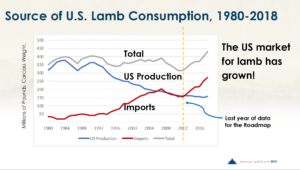
Imported lamb has captured the majority of the growth in lamb consumption by the US lamb consumer over the last decade. Primarily, because imported lamb product tends to be more available at big box stores at a more inexpensive price point.

Source of U.S. Lamb Consumption, 1980-2018

We also have competition from other high-end proteins and meatless proteins. Yes, we have a great consumer “in our backyard” but our competition is aggressively going after that consumer. We will have to fight for this consumer by providing a quality product at the right price. In addition, we have to retain consumer confidence that we properly care for our animals and the environment. This cannot be overstated.

Third, technological advancements in livestock production is mind-blowing.
It is my job to keep up with technology within the sheep and goat industry. It is very exciting that we have so much research-based information and technology. However, it is a daunting task to develop a strategy to implement this technology before it becomes obsolete.

I am very pleased to see that the US sheep industry is adopting the use of estimated breeding values (EBVs) via the National Sheep Improvement Program (NSIP). Now, we need to start devising a plan for the meat goat industry to integrate this technology as well. Not to mention, that advancements in molecular genetics is coming at us at warp speed. We must start to find a way to integrate genomic predictions into EBVs.

Vision grading integrated with RFID tags at the major lamb packing plants can now provide a highly accurate prediction of the carcass cutability of every lamb. Now producers can be paid for lambs based on the true cutability of the lamb. This data can then be traced back to production systems and genetics on the farm/ranch, allowing for rapid changes in production efficiency.

Rapid Evapoorative Ionixation Mass Spectrometry (REIMS) is being developed to predict flavor of lamb. This will allow for lamb to be classified or sorted into groups based on how the lamb will taste. It has been suggested to sort them into mild, medium, and bold flavor groups. However, this is yet to be determined.

These three things were just a few of the technologies discussed at the lamb summit; I can only image how many new technologies will be discussed at the 2021 American Lamb Summit.

Many of us whom were attracted to the sheep and goat industry like the simplicity of tending animals. In contrast, for sheep and goat operations to become sustainable into the future they are likely to become more complex than most other jobs. Although, we may want to continue to live a simple life, it does not look like this is going to be the case.

In the future, you will need to be experts at animal health care, livestock nutrition, land stewardship, marketing, business/finance, mechanics, etc. In my opinion, one of the most jarring quotes at the Lamb Summit was delivered by Dr. Henry Zerby, a meat scientist and sheep producer who works for a cooperative that supplies meat to the Wendy’s corporation:

“Too often we wonder what the costs of implementing technology will be. In reality, we should be asking… what are the costs if we don’t?”

These are exciting times! Stay tuned.

To provide feedback on this article or request topics for future articles, contact me at reid.redden@ag.tamu.edu or 325-657-7324. For general questions about sheep and goats, contact your local Texas A&M AgriLife Extension Service county office. If they can’t answer your question, they have access to someone who can.
Filed Under: Uncategorized

Reid’s Ram-blings: August 2019

August 21, 2019 by andyherring

Anthrax, Market App, and the Expo

For me, this summer has been fast, furious, and full of excitement. Travel for work and family (mostly baseball) has kept me extremely busy and I rarely have had a chance to be home or in the office for more than a day or two. “Sorry, it has taken so long for me to get back to you” has been a frequent starter to most of my emails.

In June, I had the opportunity to travel to England to get an in-depth look at the British sheep industry. It was an amazing experience and I am very grateful to the British Agriculture and Horticulture Development Board for hosting us. They have a very progressive sheep industry, look for details about what I learned across the pond in future articles.

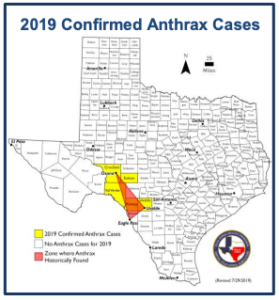
Sadly, Anthrax is wreaking havoc on ranches in certain parts of Southwest Texas this year. Our hearts go out to those who have been impacted. It is a terrible feeling to see your livestock and wildlife dying a horrible death, and our sympathies are with those who are dealing with this outbreak, in many cases for the first time. Texas Animal Health Commission has reliable information about this disease on their website: www.tahc.texas.gov. It is advised to not move unvaccinated animals from this region to other areas until the disease outbreak subsides to prevent the disease from spreading.

2019 Confirmed Anthrax Cases

We have just launched a new iPhone app to help West Texas sheep and goat ranchers make informed lamb and goat marketing decision. A team of people with Texas A&M AgriLife Extension and Angelo State University developed the Lamb and Goat Market Forecast app. Producers can input weights of lightweight slaughter lambs or kids and an estimated cost of gain (if ownership is retained) and then see predicted profit or loss based on future dates of sale. The predictions are based on over 1 million animals sold from 2010 through 2018 at Producers Livestock Auction. The app is titled “Lamb and Goat Market Forecast” and is available in the AppStore at https://apps.apple.com/app/id1467220182 (sorry Android folks, we’re working on it).

Lamb and Goat Market Forecast app

Back by popular demand, we will be hosting the Texas A&M Sheep and Goat Field Day the morning of August 16 at the San Angelo Research and Extension Center, which is a free event. Immediately following, over at the Spur Arena, is the Texas Sheep and Goat Expo, which will start at noon on August 16. Day two of the Expo runs 7 a.m.-1 p.m. on August 17. If registered before August 13, the Expo is $50 per adult.

Between the two events, there will be dozens of speakers covering most all sectors of the Texas sheep and goat industry. It is truly a program for everyone. To find out more about the event and to preregister go to: https://agrilife.org/agrilifesheepandgoat/.

Immediately after the Expo, we will be hosting a sheep sale highlighting performance based genetic selection. I am a firm believer that profitable ranches must have productive, healthy, and environmentally adapted genetics. Estimated Breeding Values (EBVs) via the National Sheep Improvement Program (NSIP) are one of the best tools to help us identify the right animals for your ranch. A catalog for the sale can be found at: https://sanangelo.tamu.edu/performance-tests/ram/

Lamb with metrics

In closing, Albert Einstein defined insanity as “doing the same thing over and over again and expecting different results.” Reflect on these words of wisdom and make it a priority to investigate strategies that could make your herd healthier, more productive, and more profitable.

To provide feedback on this article or request topics for future articles, contact me at reid.redden@ag.tamu.edu or 325-657-7324. For general questions about sheep and goats, contact your local Texas A&M AgriLife Extension Service county office. If they can’t answer your question, they have access to someone who can.

Filed Under: Uncategorized

Reid’s Ram-blings: July 2019

July 10, 2019 by andyherring

Rain Grows Grass and Parasites

Few things make a West Texan smile like spring rain, green grass, and young lambs and kids frolicking in the pastures. This year has been a bountiful reminder of the joys of livestock production.

When my early onset grumpy-rancher syndrome flares up and I catch myself grumbling as thunderheads roll in day after day, I realize that a little mud and moisture is nothing to really complain about. I also have to remind my son that rain is good thing, when his baseball tournaments continuously get rained out. We all know that it is better to have too much rain than not enough.

In reality, there is cause for some concern for those of us with sheep and goats. Internal parasites love rain and warm weather and spring storms seem to invigorate these little suckers (literally, blood suckers!). Warm and wet conditions allow the parasites that have survived in the animals over the winter to amplify on pasture at an alarming rate. The barber pole worm is the most damaging internal parasite of small ruminants and it targets the weak animals in a flock, which tends to be lactating females, young growing offspring, and animals in poor body condition.

Managing sheep and goats to prevent animal health issues from internal parasites is complex and should be a top priority for all small ruminant owners. I recommend farmers and ranchers educate themselves at the following websites: https://www.wormboss.com.au and https://www.wormx.info. These two websites have an abundance of factual and relevant information produced by qualified educators. It goes without saying that there is a lot of misinformation on the Internet if you look in the wrong places.

Lamb

I also recommend that you follow our Facebook page (https://www.facebook.com/TAMUSheepandGoats/) and YouTube channel (https://www.youtube.com/channel/UCJNtVhyg2crdb4GIrDP891Q). We have produced numerous educational videos on the most effective treatment protocols, such as using combination drenches or copper oxide wire particle boluses.

Researcher explaining sheep and goat products

However, isn’t the best way to deal with a problem is to prevent it from even occurring? With this mindset, Texas A&M AgriLife Research and Extension is working towards breeding sheep and goats that are quantifiably more resistant to internal parasites. We are using the National Sheep Improvement Program to generate Estimated Breeding Values (EBVs) for reduced fecal egg count, the primary measurement of parasitism within the animal. In addition, we are working to validate a new genomics test called Flock54, which has markers for internal parasite resistance.

Researcher explaining data in sheep pen

Although we are only a few years into these breeding programs, we have identified large differences in parasite resistance among our sheep, both wool and hair breeds. Recently, we have attained a couple of grants to conduct research and collaborate with Texas seedstock sheep and goat breeders whom are already using this technology. In other regions of the U.S., attempts at breeding for parasite resistance have paid big dividends, such as with many Katahdin breeders in the Southeast. I am optimistic that this technology will be a real game-changer here in Texas in regards to breeding sheep and goats that require less deworming. Stay tuned!

Texas A&M and other breeders who use this technology will be selling breeding animals after the Texas Sheep and Goat Expo on Aug. 16-17 that will have EBVs for parasite resistance and other performance traits. We encourage that you attend this event, even if you don’t pick up a bidders number we hope you are at least inspired to incorporate parasite testing into your management scheme. Contact your local county extension office or the district office in San Angelo to get registered 325-653-4576.

More and more evidence is mounting that a lot of what makes a sheep or goat profitable comes from characteristics that you simply cannot see. Whether it is parasite tolerance, reproductive capability, disease resistance, etc. we are realizing more of the keys to these real-world difference-making traits lie within the genetic make-up of the animal. Technology is allowing us to explore this at a level that monetarily and scientifically wasn’t possible ten or twenty years ago. The future of our industry is much brighter if we effectively we implement the tools that have been laid out for us. Either stick with traditional methods and remain stagnant or incorporate new ideas and elevate our industry to new levels.

To provide feedback on this article or request topics for future articles, contact me at reid.redden@ag.tamu.edu or 325-657-7324. For general questions about sheep and goats, contact your local Texas A&M AgriLife Extension Service county office. If they can’t answer your question, they have access to someone who can.

Filed Under: Uncategorized

Reid’s Ram-blings: June 2019

May 31, 2019 by andyherring

Travel is the Best Teacher

Do you ever drive down the road and think “That field needs some sheep to manage their weed problem!” or “Why are those folks spending so much money on mechanical brush work? I’d have a herd of goats do that job for me.”

Am I the only one who uses these lines on every journey I’ve ever taken? The sheepman in me can’t help but see potential pasture at every turn. My job provides a lot windshield time to ponder on this.

This travel also provides the opportunity to see how “somebody else does it.” In my opinion, it is always the right decision to travel and learn when the opportunity arises to take a trip, and I have been fortunate that my studies and career have allowed me to do just that.

American land grant universities are renowned for laying the educational building blocks of the stable agriculture industries our society enjoys. I often take for granted the foundation of science and dedication to research that 9 years of higher education at three of these great schools has instilled in me.

In 2017, I traveled to Kenya and Ethiopia. It reminded me how important it is to properly educate the agricultural producers of your country. Without a secure and affordable food supply, societies have issues that we rarely think about.

Young Ethiopians tending their flocks of sheep

Young Ethiopians tending their flocks of sheep

Looking back, my time in Montana taught me the most about sheep production. It wasn’t just that the university had some great teachers and top-notch advisors, but it was the drastically different production systems required to raise sheep in an environment completely dissimilar to Texas that taught me the most. Literally and figuratively, I learned there was more than one way to shear a sheep when I was working on my PhD at Montana State.

My desire to learn about agriculture and sheep and goat production did not cease when they handed me the diploma. Throughout my career I have been fortunate enough to visit ranches and farms in nearly two dozen states and half a dozen countries. Textbooks and lectures instilled the fundamentals, but the life lessons and information I receive from producers like you is what I treasure the most.

The folks who have dedicated their lives to raising sheep and goats are not all cut from the same cloth, but most share a similar set of common core values. Sheep and goat people are absolutely a brother/sister-hood. It may be a bumper sticker denouncing coyotes or a shirt that is only dirty on the left side, but you know another sheep person when you see them. They love what they do and tend their flocks and herds for the lifestyle, not the money. Farming with sheep and/or goats can be profitable but there may be easier ways to make a living. I truly believe that sheep and goat farmers are the most passionate and dedicated of all agriculturalists.

In April, I was part of an American delegation chosen by the American Lamb Board that took a weeklong tour of New Zealand’s sheep industry. Beef and Lamb New Zealand LTD hosted three Americans and three Australians on this tour, along with a delegation of young farmers from New Zealand. We visited numerous farms on both the North and South Islands.

I was impressed at their management practices and how precise their goals are. It was repeatedly stated that lamb crop is the most important factor and they shoot for a minimum of 130% lambs weaned per ewe joined with ram. This is the national average and many farms we visited were attaining 160% or higher weaning rates, and these managers were able to do this on a very large scale. According to USDA-NASS surveys, Texas generally produces an 80 to 100 percent lamb and kid crop.

In New Zealand there are 30 million sheep and the land base is roughly half the size of Texas. We have ¾ of a million sheep in Texas. Yes, Texas is generally regarded as a beef cattle state; however, New Zealand has a similar number of cattle as Texas. They are able to raise this number of cattle and sheep due to high rainfall and a temperate climate. Plus, the vast majority of land is improved pasture, growing forages for sheep and cattle (beef and dairy) production. I did not see much land being farmed for cash crops as you would in Texas.

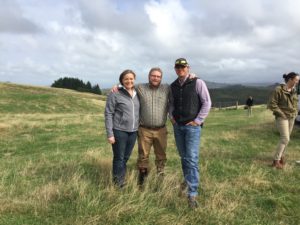
Laurie Johnson, Whit Stewart, and Reid Redden

Laurie Johnson, Whit Stewart, and Reid Redden on Lamb Industry Ambassadors Tour

If Texas is going to become a larger producer of lamb and goat to meet domestic demands, I foresee the need to dedicate farmland to forage crop production, primarily for raising lambs/kids with their mothers and potentially for grass finishing. High quality rangeland can rival cultivated ground in cash value and not to mention, livestock can be more intensively managed and predation control is much easier when there isn’t a thick stand of brush.

In June, I have the good fortune of participating in a similar tour of the UK sheep industry. I look forward to seeing the similarities and difference from the NZ sheep industry.

In August, the American Lamb Summit will take place in Fort Collins, Colo. This is a new conference looking to shape the future of the sheep industry. There will be a group of Texans attending this meeting. We are looking forward to what we’ll learn from our travels and we hope to see you there.

Thank you for allowing me to be your state sheep and goat specialist. It is truly my honor and a unique privilege. I promise to always seek new ideas and knowledge wherever I can. I’d like to leave you with this final piece of advice; always make the decision to go! You’re only one good high school kid to do chores – and a few bucks for a plane ticket – away from being forever changed in a way that only a new voyage can provide.

To provide feedback on this article or request topics for future articles, contact me at reid.redden@ag.tamu.edu or 325-653-4576. For general questions about sheep and goats, contact your local Texas A&M AgriLife Extension Service county office. If they can’t answer your question, they have access to someone who can.
Filed Under: Uncategorized

Reid’s Ram-blings: May 2019

May 1, 2019 by andyherring

Market Growing Pains

From fine dining to food trucks, dishes like crispy lamb ribs, pulled mutton shoulder pad-thai, and cabrito kabobs are popping up almost everywhere. Lamb and goat, long disregarded by backyard barbecue enthusiasts and weeknight chefs alike, has not only reemerged onto restaurant menus, but it has morphed into a force to be reckoned with amongst an evolving food scene. Eating lamb and goat meat is all the rage!

Most exciting to us producers is that long-term projections are forecasting continued increases in demand for sheep and goat products, both domestic and international. The Aussies and Kiwis are looking to exportable more and more product to geographically closer China. Current domestic production is slipping, but with the expected increase in demand, prices should stay strong. Money talks and I expect more of the ranching community to get on board with having a few sheep and goats around.

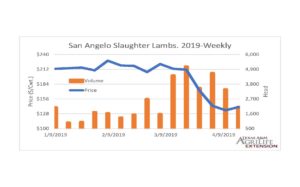
Long term is the key word unfortunately as the Texas lightweight slaughter lamb market trended downward rather sharply in early April, but a spring-time dip in prices is not totally unexpected. To most folks the longer days mean it’s time to run outside and take photos in the blue bonnets. To the sheepman? Well besides the denning coyotes being on the prowl, stomach worm boom, noxious weeds erupting in every corner of the pasture, and the shearers being late for the 8th day in a row…. I forget where I was going with this. Oh yeah, the market takes its annual nosedive. Does it have to be this way though?

The predictable drop is likely result of an increased supply of lambs. Producers Livestock Auction in San Angelo sold roughly 50% more sheep and goats per week in early April than in March. With the largest percent of these animals being lambs from hair sheep breeds, which tend to go to the lightweight slaughter market. Supply hasn’t been as markedly increased for wooled lambs and goat kids and ultimately the market for these animals remained stable.

Bill Thompson, Texas A&M AgriLife Extension economist, has been reporting the effect of supply on the lamb and goat market for a few years. This data can be found at the following website. https://sanangelo.tamu.edu/extension/west-central-agricultural-economics/small-ruminant-mpa-project/ Supply volume has consistently been the best predictor of long-term price trends.

San Angelo Slaughter Lambs (2019)

I feel strongly that sheep and goat producers should take a long look at this data and consider management practices that will allow them to market portions of their lamb crop during the late fall and winter, especially hair sheep producers who can capitalize on the aseasonal reproductive capabilities of these breeds. Market volatility limits industry expansion, so transitioning some of the lighter slaughter lambs that are hitting the traditional late spring and summer logjam to a the fall and winter could have reverberating benefits throughout the sheep industry. A consistent supply of fresh lamb product inspires confidence at each level of the production chain, and ultimately the consumer. Consumers always have and always will drive the market.

Almost daily I receive calls or emails from people in Texas who want to get into the sheep business and most all of them are looking towards hair sheep. This also begins to ask the question “Has the hair sheep industry oversupplied the market?” Time will tell, but at present, no. In the United States we have 300 million potential customers, of which most have never even tried lamb or goat. We have the potential to easily consume all we can produce domestically, but a flatter supply curve is still a must.

Folks who are interested in getting into small ruminants need to keep an open mind to raising goats. Meat goat prices have been consistently strong with less seasonal fluctuation. Plus, imported goat meat was down 30% in 2018, which had been steadily increasing the 5 previous years. The largest importer is Australia and I suspect that they aren’t able to supply the product due to drought and the feral management systems used to source goats.

In the past, most sheep and goat producers tend to be price takers. They have little control or ability to influence demand, unless they direct market to the consumer. Direct marketing isn’t for everyone but it doesn’t hurt to try to develop and grow our consumer base. My family eats lamb regularly at your home and we expose our friends and family to this great protein. It has had an impact. My extended family eats lamb regularly and my mother has added two lamb items to the menu at the family restaurant. They are selling at a pace that is far beyond our expectations. We must continue to promote our product. If we don’t eat it regularly, what kind of statement does that make to our consumers?

Also, I encourage the sheep community to stay up-to-date on what the American Lamb Board is doing to promote our product. They have fantastic programs that are responsible for some of the increased demand in lamb. A recent study by Texas A&M took a look at their impact. The report showed for every $1 invested into the American Lamb Checkoff Program it provided $14.20 to industry stakeholders!

In summary, the future is bright for the sheep and goat industry. But it is imperative for farmers and ranchers to stay up-to-date on the details of the industry. Producers should pay particular attention to supply a product that is in high demand at the time of market. Change is inevitable and we must see change as an opportunity, not a threat.

To provide feedback on this article or request topics for future articles, contact me at reid.redden@ag.tamu.edu or 325-653-4576. For general questions about sheep and goats, contact your local Texas A&M AgriLife Extension Service county office. If they can’t answer your question, they have access to someone who can.

Filed Under: Uncategorized

Reid’s Ram-blings: April 2019

May 1, 2019 by andyherring

Three Strikes and You Are Out!!!

Spring is my favorite time of the year. Green grass, newborns frolicking in the pasture, and baseball. As a youngster, baseball was easily my favorite sport. Now I am blessed to have a son that loves the game and I have the honor to be the head coach of his little league team. Naturally, our team name is the “Yard Goats.”

Springtime is also when many of our sheep flocks and goat herds are at their highest risk of predation. If you have been reading my column for long, you know that I am a big advocate for livestock guardian dogs.

If you are “still on the fence,” we are hosting a livestock guardian dog field day in Menard on April 12. The field day will include two ranch tours and various presentations from Texas A&M AgriLife employees and allied industry professionals. For more information visit our webpage: http://sanangelo.tamu.edu/events. Call the Menard County Extension office at 325-396-4787 to register for the event.

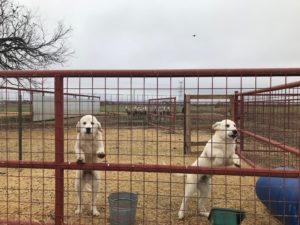
Sheep dogs in pen

I am a big fan of statistics and numbers. Maybe it is because math was my favorite subject in school or maybe it is a carry over from baseball. Specifically, I like the rule of 3.

The third time a female fails to raise twins, she is either culled or bred to terminal sires so her progeny are not kept as replacements. Unless she doesn’t lamb until she is a two-year-old, then she starts her at bat with 1 strike, so to speak. If you pasture lamb and don’t know which lambs belong to which ewes, you could pregnancy scan the ewes before lambing and use this information to employ the rule of 3.

The third time that a sheep or goat requires deworming based on bottle jaw, FAMACHA score, or fecal egg count, the animal is likely to be culled. However, it must be noted that if all animals within a similar management group are heavily infested with worms, then I don’t apply this rule. It was more of a management or environmental effect and not necessarily genetic inferiority of the animal.

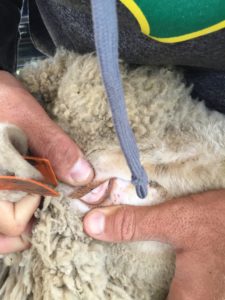
checking ewe eye

The third time a goat gets its head stuck in the fence, a range ewe needs her feet trimmed or a ram hits me in the back; they are on the chopping block. A simple way of keeping track of how many “strikes” an animal has is to notch their ear or place a “black’ tag every time they swing and miss. If you are like me, some consistent way of keeping track is vital.

The rules of 3 are easy to understand and implement by commercial producers. But science has proven that estimated breeding values produced via the National Sheep Improvement Program are much more reliable sources of genetic predictions for traits such as twinning rate or resistance to parasites. For me, I will not buy breeding animals without EBVs, unless an overwhelming amount of data has been used to make within flock decisions.

Many of you may be familiar with Billy Beane, the Oakland A’s general manager, and his reliance on statistics or you have seen the movie “Moneyball.” He has made a famous career for himself by analyzing players by their statistics over traditional methods. Some years his teams are more successful than others, but indisputably he makes the most of his roster with a smaller payroll than most other successful programs.

Hope you all have a great spring and lets “play ball!”

To provide feedback on this article or request topics for future articles, contact me at reid.redden@ag.tamu.edu or 325-653-4576. For general questions about sheep and goats, contact your local Texas A&M AgriLife Extension Service county office. If they can’t answer your question, they have access to someone who can.
Filed Under: Uncategorized

Reid’s Ram-blings: March 2019

March 6, 2019 by andyherring

Next Generation Ranchers

My job has two main audiences; youth between 9 and 18 years of age and ranchers whom are generally 55 years of age and older. This is true for most AgriLife Extension employees.

Youth programs are geared towards 4-H and FFA members, such as livestock projects and wool/mohair judging contests. These interactive programs have been extremely successful at getting youth involved with agriculture, ultimately leading to a better appreciation, if not a lifelong passion, for food and fiber production.

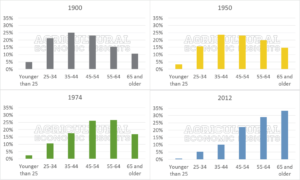
According to the USDA, two out of every three current farmers and ranchers are 55 years of age or older, and only 5 percent are less than 35 years of age. The average age of new farmers and ranchers is nearly 50 years of age.

Farmer ages, 1900, 1950, 1974, & 2012

It is an asset and a liability to have a more mature ranching community. With age comes wisdom, more financial security, and careful decisions that are more likely to keep an operation running. However, there is a forgotten generation of folks who we simply don’t target enough of our extension and industry resources to helping, and that is the young adults.

The term ‘millennial’ often leaves a poor taste in the mouth of the older crowd, but that is largely due to an ill-conceived perception that ALL millennials still live off of their parents and don’t know how to work. There is a large sector of this age group however, that do, in fact, have both aspirations and a work ethic, and are looking for a chance to thrive in agriculture

Youth brings energy and a desire for new technologies and innovation. The sheep and goat industry has a limited amount of new technologies and innovative programs being put into practice, which I would argue is a direct result of the lack of managers under 35 years of age. Is this limited number of younger sheep and goat producers a result of low enthusiasm (like we hear is the case all the time) or is it simply because opportunities are few and far between?

The current ranching community has developed an admirable courage to sustain their way of life regardless of any challenges they face. Through thick and thin, the rancher is the epitome of steadfastness. But a side effect of this can be a resistance to those who approach the ranching way of life differently than themselves. Cell phones have replaced pocket books and the internet is now the first place many of us look to for an answer to a problem, but don’t confuse this with a lack of passion for feeding and clothing the world. The love of land and livestock persists, that much you can be sure of.

A small group of folks, including myself, have started a committee within Texas Sheep and Goat Raisers Association called “TEXAS RANCHERS OF TOMORROW” or TROT for short. It is made up of TSGRA members that are less than 40 years of age and want to be active sheep and goat producers. Since 2016, TROT has hosted a couple of ranch tours each year for members to attend to learn more about making a living from ranching.

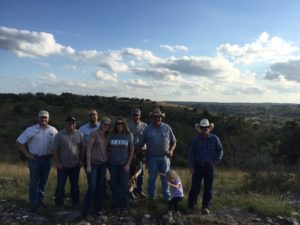
TEXAS RANCHERS OF TOMORROW group photo

Most members of TROT are part-time ranchers and rely on other forms of income to support themselves and their families. They would very much like to ranch full-time, but access to land resources prohibits that dream from becoming a reality. As we all know, land value has greatly exceeded ag valuation. Therefore, it is unrealistic for young ranchers to buy land and pay for it raising sheep and goats, or any other form of livestock, unless they inherit or earn a small fortune elsewhere. To get started in the industry, it must come from lease land.

Finding lease land for sheep and goat production has become a difficult task. Many landowners, absentee or resident, don’t want someone else on their land or only want to lease land for hunting purposes. There is also a misconception that sheep and goats don’t mix well with certain wildlife species, such as whitetail deer and quail. We all know that good land stewardship can be beneficial to both livestock and wildlife.

If you are a landowner and have land that is currently without sheep and goats, or may be in the near future, I’d encourage you to consider leasing some land to someone who’d love to have the opportunity to try and make this their living. Also, encourage your fellow landowners that don’t have active livestock leases on their land to a consider helping a next generation sheep and goat raiser get started. There is a large cohort of young adults that would be great assets to our industry, if we could find the right opportunities for them to get started.

The TROT committee is developing a directory of its members that are seeking lease land. The information gathered will include where they are located, the type of livestock they wish to raise, their education, and livestock experience. So if you don’t know of a next generation sheep and goat producer in your area and you have land to lease, this organization can help you find the right person.

While people in this industry are the most important thing to consider, the lack of production is also an important aspect. In the US, we are importing more lamb and goat meat than ever before, simply because we just don’t produce enough to meet our domestic demands. If we keep shrinking as an industry, the infrastructure to support this industry will shrink as well. Without a viable infrastructure to support sheep and goat producers, it will become harder and harder to compete with imported products.

To provide feedback on this article or request topics for future articles, contact me at reid.redden@ag.tamu.edu or 325-653-4576. For general questions about sheep and goats, contact your local Texas A&M AgriLife Extension Service county office. If they can’t answer your question, they have access to someone who can.

Filed Under: Uncategorized

  • « Go to Previous Page
  • Page 1
  • Page 2
  • Page 3
  • Page 4
  • Go to Next Page »

Subscribe

Delivered by FeedBurner

Recent Posts

  • Reid’s Ram-blings: March 2024
  • Reid’s Ram-blings: February 2024
  • Reid’s Ram-blings: January 2024
  • Reid’s Ram-blings: December 2023
  • Reid’s Ram-blings: September 2023
Texas A&M AgriLife Extension Service
Texas A&M University System Member
  • Compact with Texans
  • Privacy and Security
  • Accessibility Policy
  • State Link Policy
  • Statewide Search
  • Veterans Benefits
  • Military Families
  • Risk, Fraud & Misconduct Hotline
  • Texas Homeland Security
  • Texas Veteran's Portal
  • Equal Opportunity
  • Open Records/Public Information