• Skip to primary navigation
  • Skip to main content
  • Skip to primary sidebar
  • Texas A&M Forest Service
  • Texas A&M Veterinary Medical Diagnostics Laboratory
  • Texas A&M AgriLife Extension Service
  • Texas A&M AgriLife Research
  • Texas A&M College of Agrculture and Life Sciences
Sheep And Goats
Sheep And GoatsStaying Up-to-Date on Sheep and Goats
  • Menu
  • Welcome
  • Events
  • Blog

Reid’s Ram-blings: January 2023

January 10, 2023 by andyherring

Where do research projects come from?

This edition of Reid’s Ram-blings was composed by Jake Thorne, Texas A&M AgriLife Extension Program Specialist.

I love what I do for a career. My job provides a living for my family, it feeds a personal passion, and it allows me to be surrounded by the best type of people in the world. But I am betting exactly what we do in research/extension is probably a little hazy to most, even sheep and goat industry folks who we work with regularly. I’ll admit, it‘s not always clear cut.

For me and my family, the holiday season usually involves airplane travel to visit relatives. I don’t know why it catches me off guard, but inevitably my seat-neighbor on a flight will ask the question that everyone goes to when you are forced to rub shoulders with a complete stranger while trapped in a metal tube hurdling across the atmosphere at if-we-crash-this-is-certain-death speed…
“So… what do you do?”

I swear I never answer this question the same way twice. Consider it a lifelong ambition to find the perfect one sentence response that explains my job clearly and floods the likely non-ag employed questionee with complete understanding. It’s a work in progress. My current go-to is, “I study/analyze/read about/talk about/ write about/stare at sheep and goats, and then do my best to help the folks who are kind of into that too.” Like I said, I think it needs some tweaking…

But in reality, what we do is a little complicated and so now that my attempt at witty writing has sucked you into this article this far- here goes.

Our research projects at the center are born from ideas of how to benefit the sheep and goat industries. But there is a caveat- research costs money, money that we usually need to seek out in the form of a grant. Grants can be offered from many entities- private or government, but they usually are tied to advancing a cause or purpose.
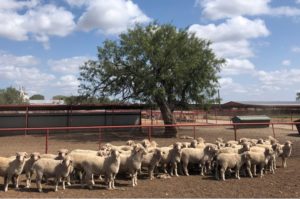
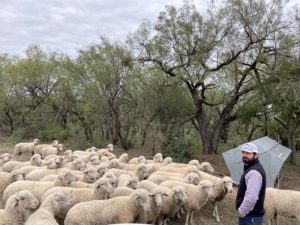
Rambouillet Rams at San Angelo Research Center

Rambouillet Rams at San Angelo Research Center enrolled in National Sheep Improvement Program that also serve in research efforts


In small ruminants, we are fortunate to have a couple of granting bodies that are dedicated to helping our specific industries improve, and for this we are very grateful! However, some of our larger research programs also require us to seek funding from sources such as the USDA, because of the larger dollar amounts they can offer.

To receive these grants, we need to write applications that align with the initiatives of the USDA and clearly explain how the proposed project will be beneficial to a broad section of the industry, is novel science (and is a foundation for future projects), and show there is a clear plan is in place of how to execute it. Sometimes these projects address an immediate concern for the sheep and goat industries and sometimes they satisfy a more long-term vision of what is to come.

A review panel then compares our grant application against a pool of others and decides which ones to fund. For perspective, getting funded one-third of the time in some fields is a success. Think baseball here – a career batting average of .333 means you’re a sure-fire hall of famer. But that also means in many cases we don’t receive funding and the project needs to be redesigned or else it pretty much ends before it ever gets started. Once the funding is secured though, the work can begin.

Why is research expensive, and how much are we talking? Research academics are evaluated by their employers (universities) in many ways, but a major criteria is the number and impact of articles they publish in peer-reviewed journals. Consider this a universal grading system across all fields of science. To publish an impactful article, the science often needs to not just be a repeat of what someone else has done previously and it needs to be done on a scale to definitively answer a question. All the resources, including equipment, animals, lab supplies, testing materials, worker salaries, and overhead, to accomplish this can add up pretty fast.

For a project to be large enough to find significant results, it is not uncommon for these costs to be in the tens, if not hundreds of thousands of dollars. While this seems like a lot, science can be a bit of “you get what you pay for.” Good information comes with a price tag. From these projects, researchers will compile the results into an article and submit it for peer review (which can be stringent, and for good reason). Multiple published articles a year, per researcher, is typically the university’s expectation. There is a saying in academia “publish or perish,” and it can be pretty accurate.

For those in extension specialist roles, the job is a little different. Whereas research conducts science and compiles information from a project, it is the role of extension to disseminate these results to industry stakeholders. As a specialist it is necessary to understand how the industry works and it’s needs for progress, but at the same time, have knowledge of the capabilities of science and what can be accomplished. When something is learned in the lab, how it can be applied on the farm is not always a given, thus extension plays a very important role in the translation of that information. Often this includes conducting “applied research” which are projects that test a tool or strategy developed through “traditional research” to solve an immediate industry concern.

Conducting collaborative projects that involve producers and successfully applies new science/information can also be very successful and gratifying. At the same time, working directly with producers in a hands-on way allows us to better understand their challenges and how not-yet-developed technology could possibly benefit their operation. How do these applied and collaborative projects get paid for? You guessed it- grants. How do we show if these projects were successful? In many cases, publications.

I can’t say for sure what compelled me to write on this topic, but I wanted to give a bit of perspective on how the wheels turn in research and extension. There are also A LOT of perks to the job- namely that we get to work with livestock and for those that raise them for a living. We get to travel, we get to network, and every day is different – though livestock workdays are the best!

With this said, my next flight leaves in a couple days… any suggestions on how to condense this into one sentence?

To provide feedback on this article or request topics for future articles, contact me at jake.thorne@ag.tamu.edu or 325-657-7220. For general questions about sheep and goats, contact your local Texas A&M AgriLife Extension Service county office. If they can’t answer your question, they have access to someone who can.
Filed Under: Uncategorized

Reid’s Ram-blings: December 2020

December 16, 2020 by andyherring

What a Year!

I am confident that 2020 has been the most remarkable year of my life. Generally, we might think that the milestone years are those which we were born or married or had kids. Yes, those were great years, but they don’t hold a candle to what took place in 2020.

My heart goes out to all those that suffered significant hardship this year. Many people lost their jobs, lost family members, or had their world turned upside down due to COVID-19. And there is serious anxiety and depression lingering from the lack of uncertainty in this world: not to mention the political upheaval that we have had to endure.

I feel somewhat guilty but 2020 brought good changes in my life: new job responsibilities, new colleagues, less time on the road, and a new outlook on what is important. Yes, there were some nasty parts to 2020, but I seem to have the ability to block them out, a trait that I have to thank my mother for.

If you are a long-time reader, you have figured out that I am an optimist. Two decades ago, I knew that sheep and goats would be my life’s work. But at the time I had no rational for choosing this life- rather, it chose me. Up until recently, I have had to be creative to paint a rosy picture for what the future of the industry “could” look like. Honestly, the reality has been bleak: A half century of a declining industry, due to attrition of producers that could not make enough profits to be sustainable, brought on by lack-luster markets, constant predator pressure, and a diminishing infrastructure to support sheep and goat producers.

But I have learned to never bet against sheep and goat raisers. They are some of the most resilient people. Now, I can feel confident that a bright future does exist for those that want to put in the hard work and raise small ruminants.

MARKETS: The traditional lamb market, which is the primary marketing channel for 130-160 lb lambs, has made a quick rebound from the COVID-19 market crash. In my opinion, the abrupt shut down of the food service demand for lamb should have been the nail in the coffin for the domestic lamb industry. Yes, we lost a lamb packing plant and lamb cooperative in the process. But there are two new high-capacity lamb processing plants that opened their doors in 2020. And based on the current market, it appears the traditional U.S. lamb consumers have continued to support U.S. lamb producers.

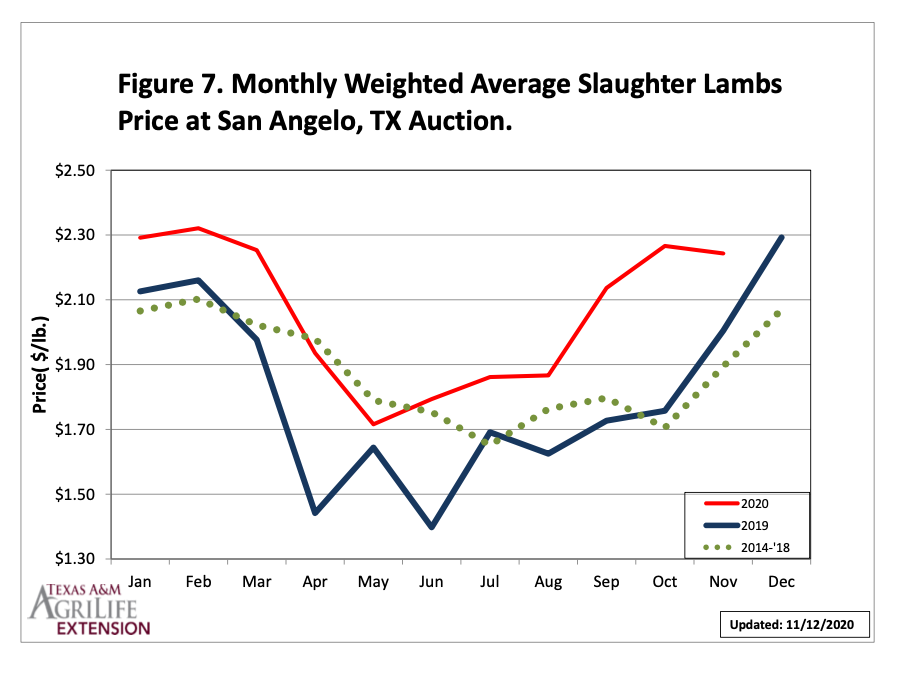
Here in Texas, the majority of our lambs go toward the non-traditional market, which favors lighter weight lambs. Other than the months of April and May, the lightweight slaughter lamb market in 2020 was well above the 5-year average. More impressively, the supply of lambs that have been marketed at our sale barns in the state has been growing. Typically, prices go down with increasing supply. This again speaks to the strength of the demand for lamb products.

2020 Lamb Market

2020 Lamb Market

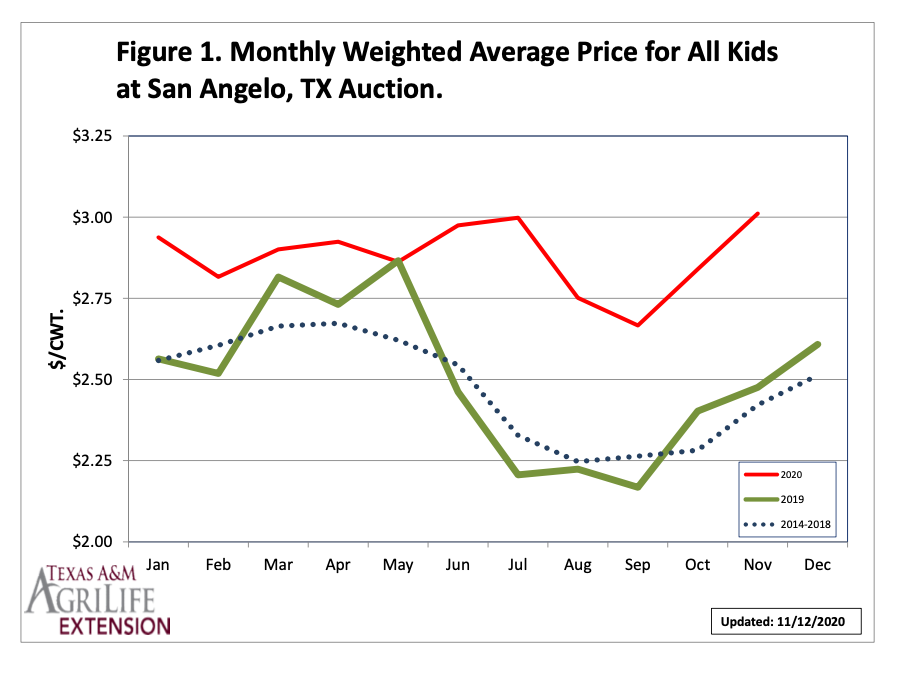
And, WOW, the meat goat market has been on FIRE. The month of September is the only time that the average kid goat was below $275 cwt. Not only are kid goats selling well, but adult goats are also fetching a premium. This strong market occurred in the face of pandemic and major holidays that fell in typical high-supply seasons.

2020 Goat Market

2020 Goat Market

It seemed as if fate is stacking the cards against the sheep and goat market. And yet, it has been prevailing with nothing but strength, but maybe I am too optimistic.

PREDATOR PRESSURE: No doubt that predators are still wreaking havoc on sheep and goat producers. And there is no sign of them going away anytime soon. The bright side has been the growth in use and acceptance of livestock guardian dogs (LGD) in Texas. We have partnered with the Texas Sheep and Goat Predator Management Board to conduct research and provide educational support for people that are wanting to use LGDs.

Skeptics will say that LGDs can be more hassle than help, and I’ll be the first to admit they are not for everyone. But as the sheep and goats are starting to expand into the panhandle, and further east in the state, areas historically dubbed “cow-country”, LGDs are making believers out of many of these newer producers. Here in the Edwards Plateau region, LGDs are also becoming more of the norm as opposed to an occasionality. They are not the sole answer to the predator issue but ask any of those who have come to rely on their services, and I think they’ll tell you there is no going back to the pre-dog days.

LACK OF INFRASTUCTURE: In the early 2000s, there was a poor outlook on resource allocation for small ruminants. It seemed like new research, pharmaceuticals, next generation equipment, and other technology would never be developed for sheep and goats, as the industries are not big enough.

None of this happened! On the contrary, universities reinvested in small ruminant educators and researchers. New research funding opportunities have materialized. New networks of educators, researchers, and industry leaders have formed. Sheep genetic technologies have grown at a faster rate than ever before. Foreign companies have invested in distribution of equipment specially designed for sheep and goat production.

2020 has been a crude trip around the sun for many, but I can’t help but find the blessings that have come from the turmoil. Like I said before, never bet against sheep and goat raisers. A resource group of people that find ways to survive the hard times and prosper in the good times.

To provide feedback on this article or request topics for future articles, contact me at reid.redden@ag.tamu.edu or 325-657-7324. For general questions about sheep and goats, contact your local Texas A&M AgriLife Extension Service county office. If they can’t answer your question, they have access to someone who can.
Filed Under: Uncategorized

Reid’s Ram-blings: October 2020

November 2, 2020 by andyherring

The spring fruits of your fall labor

After a sweltering summer, the self-described “Sheep Country” of Texas was finally muddy last week, and overnight a green hue returned to the landscape. While more fall moisture is definitely welcome, this timely rain arrived at a critical time to promote cool season grass and forb growth leading into winter. This also coincides with breeding for most Texas sheep and goat producers and lambing for those who intend to capture seasonal price spikes. Regardless of your production cycle, this nutritional uptick for livestock on pasture will have significant benefits on your lamb and kid crops, even if they are six months away from arrival. However, producers of small ruminants need to monitor the condition of their herd or flock closely to maximize the reproductive output of their animals.

If you are a long-time follower of this column or our AgriLife Extension program, it is clear that we are big proponents of body condition scoring ewes and nannies on a regular basis (at least two to three times a year). Prior to breeding is a critical time to ensure this somewhat tedious task gets accomplished. Condition scores in small ruminants are on a 1-5 scale, with 1 being extremely thin and 5 being obese. Most sheep are between a 2.5-4; animals with scores outside this range need a closer look in order to identify the potential causes. Some immediate management decisions may be required… even if the cause is just an overly generous feeding program!

Farmer with herd of sheep

Supplementing Ewes Prior to Breeding Season

A closer look at your ewes and nannies also provides an opportunity to cull any that will not be able to properly raise offspring. Check for teeth issues that can lead to poor nutritional intake and any residual udder problems that have remained from the previous lambing. Capturing the condition score of your mature females may allow you to take advantage of flushing or keep you from wasted expense on this added feed supplement.

“Flushing” is a term that describes increasing the nutrition of the herd ~3 weeks prior to and ~3 weeks after exposure to a male to increase ovulation rate, and ultimately lead to more offspring. If ewes or nannies are in a body condition score (BCS) of 2.5 to 3.0, flushing can be highly effective. However, if the females BCS average 3.5 or more, there will be no added benefit to flush them. A typical flushing ration would include a high-energy concentrate, e.g. corn, delivered at about 1 lb. per head per day. Recent rains should increase pasture quality, so perhaps starting at ½ lb. per head per day is more advantageous, but pasture quality and optimal flushing ration could vary by operation.

Not to be taken for granted, rams and billies also need extra attention as breeding season approaches. A Breeding Soundness Exam (BSE) for your stud battery is always a good idea to ensure rams and billies are fertile and in the proper condition. This is a MUST if you plan to single-sire mate. There are several extension resources available online about how to perform a BSE. In short, you want to check for abnormalities in the testicles that may indicate the presence of a disease and/or infertility, evaluate the condition of the ram (3.5 is usually about ideal), and ensure that structurally (predominantly feet and legs) the male is capable of traveling the pasture and covering females. Another important component is to collect a semen sample to test for sperm motility and morphology. We suggest contacting your local veterinarian for assistance with this.

Mature/experienced rams and billies will usually expend less energy mating than younger males, who will often service females more than necessary. For these reasons, the recommended breeding ratio of females to males is usually around 40:1 for mature males and 25:1 for younger (2 years old or less) rams/billies. The breeding ratio may need to be adjusted based on your pasture size. If you have interest in monitoring sire and dam pairings, a marking harness with a colored crayon will show which females were mounted. While using DNA technology is the most accurate method for determining parentage of offspring resulting from multi-sire mating, using marking harnesses is certainly a cost-effective approach. Daily recording of these colorful “marks” can also allow you to estimate an approximate lambing date for the ewe. Any experienced shepherd will tell you, utilizing marking harnesses with younger rams usually provides a good chuckle.

Here in Texas, we have the largest sheep and goat populations of any state, but we also struggle with having comparatively low kid and lamb crop percentages. Predation is absolutely a big component of this, but sometimes tunnel vision causes us to focus on predators as being the sole reason for the underwhelming output from our herds and flocks.

Often, there are other management issues that are significantly compromising the lamb or kid crop. To wean a lot of lambs, you need to start with a lot. The first step to a higher percentage is proper management prior to and during the breeding season. Going in to breeding, all females need to be capable of conceiving, carrying, and raising offspring.

All males need to be fertile and in the proper condition to endure a successful breeding season. This discussion is timely as most producers tend to breed in the fall in synch with seasonal reproductive tendencies of small ruminants. With that said, I encourage you to look into strategies to alter the timing of breeding slightly to capture price advantages found during times of lower supply. That however is a topic for another day. For now, I hope you enjoy the rain and cooler weather and here’s to a profitable 2021 kid and lamb crop!

To provide feedback on this article or request topics for future articles, contact me at reid.redden@ag.tamu.edu or 325-657-7324. For general questions about sheep and goats, contact your local Texas A&M AgriLife Extension Service county office. If they can’t answer your question, they have access to someone who can.
Filed Under: Uncategorized

Reid’s Ram-blings: September 2020

October 19, 2020 by andyherring

Farming Sheep and Goats

The title of “Rancher” is highly regarded. It envokes admiration from most and carries connotations of savvy business skills and knowledge of all things animal. It is also rightfully associated with a long list of prideful adjectives; such as hard working, honest, and humble.
Sheep-men and -women in the Southwest and Western parts of the US generally carry this title.

But this is not true in other parts of the US and around the globe. In contrast, sheep “farmer” is the title that they generally feel is more fitting. More ball cap and less silver-belly, but still just as prideful about their 5 am – 9 pm daily efforts.

What is the difference between farmers and ranchers? In my assessment, ranchers tend livestock on native range and are naturalists. Farmers raise sheep or goats on farmland, improved pastures, or small acreage. Ranches are low input operations and survive on modest levels of productivity per animal. Farmers strive to maximize farmland outputs and maximize flock/herd productivity, often by supplying more inputs per animal, namely feed resources.

For a chuckle, watch Baxter Black’s video on the difference between the two: https://www.youtube.com/watch?v=PDrFDnqde54

It is not my intent to try and convince ranchers to become farmers but it my assessment that farming sheep and goats has been overlooked for cash crops. Internationally, sheep tend to be managed under farming condition, which allows them to raise more animals on less land.

In New Zealand and much of Australia, there seemed to be a large focus on forage crops for sheep. Ryegrass and clover were the dominant pasture forage. While this is an annual crop, these improved pasture varieties persisted for half a dozen years. They were also working on developing warm season annual crops to fill in the summer forage gap.

For instance, a farm that I visited in South Australia raised ~10,000 sheep on ~3,000 dryland acres and their average annual rainfall is comparable to the Concho Valley. Here we would have a stocking rate of 1/10 of theirs.

In the US, we tend to only focus on warm season perennial grasses as improved pasture. This tends to work well for beef cattle but not as well for sheep and goats. These warm season grasses are less palatable to small ruminants and they harbor the most problematic internal parasites.

Yes, it is a common practice to plant winter cereals as a cash crop and graze them in the fall and winter. But, by design, the genetics of these crops tends to focus on grain or hay production. Moreover, limited research has looked at planting cool season annuals into pasture.

I believe farmers (and maybe a few ranchers) need to investigate cool and warm season forage crops suited for sheep and goats that work in either farmland or fertile. pasture. While this has not been a major focus area of research, there are some resources that are available. Specifically, I encourage you to look at the forage variety trials that Texas A&M AgriLife conducts. http://varietytesting.tamu.edu/forages/

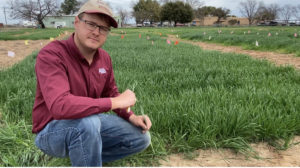
Dr. Reagan Noland at AgriLife Center in San Angelo

Dr. Reagan Noland manages forage variety plots located at AgriLife Center in San Angelo

This is definitely not an area of research that I am that familiar with and I encourage you to seek advice from a Texas A&M AgriLife forage agronomist in your area. However, I do know quite a few ranchers and farmers and know that most are opportunistic by nature. Sheep and goat prices are catching the eye of many outside of our industry, and even those that have small ruminants already are looking to expand. Acquiring traditional ranchland can be expensive and challenging to pencil out with livestock alone. But thinking outside of the traditional ways to run sheep and goats, farm ground or fortified pasture may make it possible to flip the discussion from “how many acres per sheep” to “how many sheep per acre”. Whether you call that farming or ranching is just a side note to a more important label; “profitable”.

To provide feedback on this article or request topics for future articles, contact me at reid.redden@ag.tamu.edu or 325-657-7324. For general questions about sheep and goats, contact your local Texas A&M AgriLife Extension Service county office. If they can’t answer your question, they have access to someone who can.
Filed Under: Uncategorized

Reid’s Ram-blings: August 2020

August 10, 2020 by andyherring

A New Normal

It is hard to believe that just 4 months ago, our world was turned upside down due to the COVID-19 virus and efforts to stop the spread of the virus. I hope that none whom are reading this article have had serious health complications due to this virus. While, we may agree or disagree with how our local, state, and national government are handling the situation, I think we can all agree that there is no going back to the way things were.

So, this begs the question “What will our new normal look like?” It is a question that I ponder frequently, and I am curious to see how this all unfolds. I am an eternal optimist, maybe one of my faults. Regardless, I believe we are going to look back and wonder why we did not make some of these changes sooner. This new world if forcing us to do things that we thought were impossible before.

It easy to overlook positive trends when the news is crowded with angst and concern. According to data published online by Bill Thompson, Texas A&M AgriLife Extension Economist in San Angelo, most all classes of sheep and goats are selling well above last year and 5-year averages. Wool and mohair have not fared as well. Likely because they are tied to international trade issues more than the local live animal trade.

Meat Goat Market 2020

Meat Goat Market 2020

Why has the local sheep and goat markets have remained strong while, other livestock commodities have drop significantly? Did the American consumer wake up to the high quality protein provided by sheep and goats? It will take time for the data on lamb and meat goat consumption to be generated, but I highly doubt much has changed. I tend to think that the secret to the sheep and goat market is diversity.

To be clear, there have been substantial drops in the traditional lamb market due to COVID 19 but most Texas sheep producers do not market to this trade. The non-traditional light weight lamb trade is holding strong and the meat goat trade has exploded.

Now, back to diversity. The non-traditional trade has a diverse consumer base and a diverse supply chain. Whereas, traditional meat industries have consolidated meat packing, processing, and distribution into a few major facilities that are large and highly efficient. When, a mega-packer has to shut down it can send shock waves throughout the industry.

I am not advocating for one or the other. If possible, it would be ideal to have some of both. We need small packers to support the local meat trade. We also need major packers to efficiently supply product from coast-to-coast to complete with imports. But the reality is we need lamb and goat demand to continue to grow so that both small and major packers can get the volume to keep the doors open.

It is estimated that there are a quarter million sheep and goat farms/ranchers in the US. If every person that raised sheep and goats promoted consumption of lamb and goat meat to their friends, family, and local community it would be one of the largest sales forces of any product. In my opinion, we would have a hard time raising enough product to meet the US demand if we took this charge seriously.

If you think I am wrong, I challenge you to one question “Beef: It’s What’s for ____.” Most every farmer and ranchers knows this marketing campaign and they wear it with pride. But American farmers and rancher rarely show the same kind of pride when they promote lamb or goat meat. Why not?

To provide feedback on this article or request topics for future articles, contact me at reid.redden@ag.tamu.edu or 325-657-7324. For general questions about sheep and goats, contact your local Texas A&M AgriLife Extension Service county office. If they can’t answer your question, they have access to someone who can.

Filed Under: Uncategorized

Reid’s Ram-blings: July 2020

July 20, 2020 by andyherring

A World of Experts

I cannot think of a more influential technology for delivering a message than social media. The cascade of events over the last 50 years that resulted in a computer entering every home, then the worldwide adoption of the internet, and ultimately the redefining of human-to-human interaction driven by the likes of Facebook and Twitter has created a world where communication is almost unrecognizable as compared to a decade ago.

Texas A&M AgriLife Sheep and Goat Extension Facebook page

Follow Us on Facebook

It is my job to spread ideas and technology to ranchers in the small ruminant industries, and as we speak a simple video, I created for our extension Facebook page showing a piece of equipment to handle goats has been viewed by 8 million people! That type of response is something that should incite a backslapping and high-fiving frenzy amongst our office. So why is it that we still approach posting on social media with a tingling sense of both positivity and trepidation? Like most unfathomably beneficial tools, there is a darker side to social media that must be understood and properly navigated, because a single mouse click has the power to turn good intentions into serious hot water.

In agriculture, not just sheep and goat production, we have an ever-increasing disconnection with the end consumer. I know we all have read something or heard a quote from a city-dwelling critic of how animals are raised and shaken our head in disgust. How could they think that way? The truth is, most people are not as foolish as we would like to think they are, but as a species we tend create a reality in our own minds about everything, even the stuff we know nothing about. For those not connected to agriculture in any way, how farming and ranching really works is a complete unknown, so their perceptions are easily shaped by the talking points of others.

Social media fuels this snowball effect as we tend to surround ourselves in the digital community with like-minded individuals. But that’s not even the point I am trying to make. With the disconnect between farmer and the public quite apparent, we have encouraged our fellow agriculturalists to “tell their story.” Quite simply, pictures and posts on social media about your daily interactions with the animals you raise has the power to shed positive light about the industry and agrarian way of life.

At nearly every conference and or leadership event I have attended where the discussion has turned to creating visibility to the end-consumer, the mantra has been “Post!”, “Post!”, “Post!”. Before you do though, I want to provide our own experiences with building a social media campaign, because even though we have not had any major incidents, just because you post with the best of intentions, it is important to know not everybody will see it through the same lens… and often the harshest critics are our neighbors.

I’ll call this next part, “Lessons from the Facebook Frontier.” Our page has around 10,000 followers, which in all reality is not that many, but it is enough that we expect each of our posts to be seen by several thousand folks. There is potential for us to put something on Facebook and by the next day it has been seen by the same amount of people that attend an Aggie football game. Wait a week and that might equal all the people who watched the football game. For those of you who wish to use social media platforms to promote agriculture (or any business, really), we have a little advice. Here is what we have learned what to do and not to do –

1) DO allow, and encourage, comments on your posts. This creates interaction and promotes sharing and discussion of the information, and all around is beneficial. DO NOT get caught up by negative comments. Inevitably, someone will say something a bit “snarky”, or even worse, and it is very easy to dwell on. We typically brush off comments that are obviously foolish. Best case scenario is when a fellow ag producer defends you with honesty and integrity.

2) DO include photos in your posts. Pictures connect with people significantly more than just words. We (humans) believe what our eyes see but are more likely to question or ignore what we read or hear. Pictures are worth more than a thousand words online and often a simple, or no caption, are even required. Bonus points for pictures of animals. Double bonus points for baby animals. If you are working livestock, definitely describe what and why you are doing.

3) DO post about the drawbacks and negatives of farm and ranch lives. Seeing the “other side” of the story is usually appreciated by viewers as everybody is faced with positives and negatives within their careers and by you showing (and describing) your adversity it helps to create a sense of relatability. DO NOT Describe your problems and how it is somebody else’s fault. Describing a situation, showing both sides of the story, and letting others draw their own conclusions is infinitely more powerful.

4) DO share, comment on, and promote posts by fellow agriculturalists who have similar messages as you. Regularly posting on your page to maintain a steady stream of interest can be exhausting if you are trying to develop new content daily. Often by sharing posts or interactions with others you are able to publish new posts that are equally as impactful without the need to create something new by yourself. DO NOT post or share articles or content from others without vetting their source. The saying “not everything you read on the internet is true” needs to be amended to “almost nothing you read on the internet is true.”

5) DO go live and share videos. Social media is crowded with people who have found the success of posting photos. But most people are terrified of being behind a live camera. Viewers recognize this and are more attracted to videos. If a picture is worth a thousand words, live video is worth a million words. Once we stepped into the world of Facebook live, our audience grew tenfold. Do invest in equipment to stabilize the camera and drown out the wind noise.

This is far from an exhaustive list of how to be successful through social media promotion, mostly because we have not figured out the perfect formula ourselves. New technology generates excitement amongst its users and provides everybody a voice to share their views and stories. You have a great story; so tell it to the general public or someone else will tell it for you. “If you want something done right; do it yourself!”

To provide feedback on this article or request topics for future articles, contact me at reid.redden@ag.tamu.edu or 325-657-7324. For general questions about sheep and goats, contact your local Texas A&M AgriLife Extension Service county office. If they can’t answer your question, they have access to someone who can.

Filed Under: Uncategorized

Reid’s Ram-blings: June 2020

June 17, 2020 by andyherring

Adding to the Menu

Nearly 10 years ago, I made the commitment to eat lamb on a regular basis. It was a slow process but now lamb is the most common protein eaten at our household, especially during the COVID-19 pandemic.

Growing up we did not eat lamb or mutton. These products were not a staple of our diet and we lacked the knowledge to prepare an array of lamb or mutton entrees.

My hometown community had a negative opinion of lamb, which most people accepted as true without direct experiences. Cabrito, young goat, was a delicacy and only a few pit masters in the area dared to cook it. Yet, most of the goat meat never made it to the serving line, as the cooks (and loiterers) ate it straight off the pit.

We were typical “Beef Loving Texans.” Although, we raised more sheep and goats than cattle, it rarely crossed my mind why we did not support these industries similarly to our support for the beef industry.

Lamb, mutton, and goat meat have unique flavors and aromas, which my children truly enjoy as they have grown up eating these on a regular basis. However, my wife and I had to learn to appreciate that they are different from other red meats.

Lamb sliders

Lamb Sliders

As you are likely aware, flavor comes from the fat. To me, lamb flavor has a sweetness to it that other red meats do not. I’ve come to hold it in high regard. Mutton has a bolder flavor that can be too much for those who don’t eat sheep meat regularly.

Diet of the animal when the fat is deposited can change the flavor. Grains tend to result in milder flavor; whereas, grass tends to result in bolder flavor. The older and fatter the animal the more intense this can be.
Odor is released from the fat during the cooking process. In some cases, the smell from this can resemble how the animals smell alive, which obviously turns people away. This is compounded when cooked inside a home and/or a sealed cooking method. If the raw product has mild animal odor, it will likely be more prominent during the cooking process. As such, I suggest cooking it outside!

For me, the smell of sheep or goat does not come through in the flavor of cooked product. Mutton or goat meat, particularly mature billies, can have this effect. For many international cultures, these more intense flavors are actually preferred, and they have honed their cooking techniques to make them more pleasing to the palate. I would suggest trying a recipe outside of what is considered traditional American fare if you want to experiment with mutton, and I bet you will be pleasantly surprised.

Lamb fat has a lower melting point than beef, which can result in flare ups on the BBQ pit. Keep a close eye on lamb over an open flame! The fat also tends to congeal at a lower temperature, so to me it is important to eat lamb while it is hot or the fat will become tacky. This tackiness will stick to the roof of your mouth and provide an undesirable eating experience. If the majority of the fat is cooked away, then temperature is not as important.

Some people have a difficult time overcoming prior perceptions and they may never be able appreciate these products. Others can overcome these barriers quicker and will likely be a “fan of lamb” in shorter order. Fortunately, the poor perceptions of sheep and goat meats are fading away and the general public are less antagonistic to these products from the beginning.

Often I hear stories of people who have tried lamb in a restaurant and the dish was prepared with an over-abundance of spices and sauces to mask the flavor. My advice is to start simple, grill some chops at home with your favorite steak spices, and don’t bother with a sauce. You can always add more next time, but simplicity almost never fails in this case.

Bacon Wrapped Lamb Burger Steak

Bacon Wrapped Lamb Burger Steak

Lamb and goat meat are expensive to purchase at the grocery store, particularly compared chicken or pork. Generally, grocery stores only carry the more expensive cuts that sell for $5 -15 per lb. They tend to have higher margins built in because their sales volumes are low. But they regularly discount lamb or goat meat products to market them before it expires. This is where we started sourcing it.

Cheaper imported products can be purchased but I prefer to support American farmers and ranchers. Plus, I like domestic product better than imports, and I am always perplexed when I see lamb on a menu and it is marketed as being from New Zealand or Australia. While I believe imports have their place, I also believe we have the best product in the world here in the US.

A less expensive way to source lamb or goat meat is to take live animals to a local butcher and purchase half or whole animals. This keeps the overall costs down. It also keeps a supply of product in the freezer to be used without planning too far ahead. Processing costs generally add $2-4 per pound, plus you have transportation costs both ways.

The most cost-effective way to put lamb or goat meat in your freezer is to harvest and process the animals yourself. Currently, this is my preferred strategy. For $4 to 6 per pound, I have several diverse cuts that I can prepare in a number of ways and maybe more importantly my children learn first-hand where our meat comes from. The time spent harvesting, processing, and packaging go by quick and are completely worthwhile.

Making the transition to eating lamb and goat meat on a more regular basis takes time and effort. But I have valued the process immensely. Prior to this, I was jaded with perception and unfamiliarity. Not only do we now get to enjoy some of the finest proteins around, but I can promote my industry with experience and conviction. Eating homegrown meat is enjoyable not only to the palate, but the sheep producer in me realizes the opportunity I have capitalized on to raise, harvest, and eat my own food.

To provide feedback on this article or request topics for future articles, contact me at reid.redden@ag.tamu.edu or 325-657-7324. For general questions about sheep and goats, contact your local Texas A&M AgriLife Extension Service county office. If they can’t answer your question, they have access to someone who can.

Filed Under: Uncategorized

Reid’s Ram-blings: May 2020

May 6, 2020 by andyherring

Looking Beyond Dewormers

This edition of Reid’s Ram-blings was composed by Jake Thorne, Texas A&M AgriLife Extension Associate. Jake has been a contributing editor to this column over the past year and is a valued asset to the sheep and goat Extension team at the San Angelo center. Enjoy!

Mr. Jake Thorne

Mr. Jake Thorne

The destructive power of microscopic bio-agents may not have been on your mind two months ago. We can now throw that blissful lack of worry right out the window. COVID-19 has brought the world to a screeching halt, but you are undoubtedly seeking a new topic for your daily dose of reading, so here’s something that may, or may not, put your mind at ease. Your sheep and goats have parasites, specifically haemonchus contortus, and these worms are killing your animals. See, don’t you feel better already?

In all seriousness, internal parasites are not a new theme or topic if you’re a long-time reader of this column. However, they are perhaps the single greatest issue we face in the sheep and goat industry here in Texas and are worth discussing every chance we get. If you are looking for drenching protocols or how to perform fecal egg counts, we have some great videos on these topics on our Facebook page and a sister YouTube channel. I suggest you check it out if you haven’t already done so. With that said, I want to dive a little deeper into a different aspect of parasite management; identifying animals that are resistant, and what that word really means.

Some sheep and goats are able to withstand parasitic infections from the barber pole worm (H. Contortus) much better than others. The barber pole worm resides in the abomasum of ruminant livestock and uses a spear-like tail to puncture the lining of the stomach and feed on the blood of the animal. In the meantime, female worms shed around 5,000 eggs per day. Barbaric and prolific…an effective combination for survival! While mechanisms for host resistance to barber pole worms are complex and still being discovered, research has consistently linked more resistant sheep with higher levels of Th2 helper cell activity, aka a stronger immune response. Immune cells that defend the host against parasites (eosinophils), quicker tissue repair, mucosa secretion in the gastrointestinal tract, and IgA antibody production are all results of increased Th2 activity.

Considering worm resistance to drenches is rampant and that approval of new anthelmintics is not on the horizon, selecting for animals that are genetically capable of combating parasites is crucial. I may be going out on a limb, but in my opinion this may actually be the single most important selection criteria you should have. With that said, one of the greatest mistakes producers make is believing certain animals who are not showing outward signs of parasites are more resistant when in reality they have just not experienced the same “stress” as others in the flock. For example, let’s say we have two sheep, Shrek and Dolly. We have performed a fecal egg count (FEC) on both (a FEC is a way of quantifying the eggs that are shed from the animal in the fecal matter thus allowing us to estimate the worm load in the animal). Shrek has a FEC of 500 eggs per gram (epg) and Dolly has a FEC of 3,000 epg. Seems like a no brainer as to which is more resistant, right? However, what if Shrek did not raise a lamb this year and Dolly currently has a set of twins? These two animals are not able to be accurately compared because the environmental effect (everything that affects an animal other than its genetics) is skewed. We know something called the periparturient rise exists, which is a situation where at the time of parturition the immune system of the dam becomes suppressed and parasites typically flourish, potentially confounding the comparison described here.
Therefore, to identify animals that are more resistant to parasites, we need to level the environmental playing field. The preferred way to do this is to identify a contemporary group of lambs or kids, manage them similarly, and then before they enter into production (lambing or kidding) collect fecal samples and have these analyzed. Common times to collect are at weaning, 60-90 days post weaning or when the animals are a year of age. Instead of having preset dates however, the correct time to collect is when the animals have had some exposure to parasites (they aren’t naïve) and are carrying a moderate load.

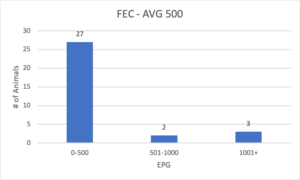
A moderate load can be defined when the average of the contemporary group is between 500 and 1,000 epg. One thing to keep in mind is that the correlation between levels of genetic resistance and actual fecal egg counts are not linear, i.e. you likely won’t find a steady rise in the egg counts of this group. More likely, most animals will be at or below the average and a few will be as much as five to 10 times the average! For example, in 2019 at the TAMU Research Station in San Angelo we analyzed FECs on 32 six-month-old Rambouillet sheep. The egg counts ranged from 0 to 4,350 epg, and results are depicted in the bar graph below:

FEC Chart

From the analysis we learn that 27 of the 32 animals in the group are at or below the contemporary group average (500 eggs per gram). With that said, the top 5 head (~15%) with the highest egg counts are shedding 72% of the eggs for the entire group. Let’s say each of these animals is producing 1 kilogram of feces a day, we can multiply their egg count by 1,000 to get the number of potential parasites they are shedding on pasture each day. The five sheep with the highest egg counts in this group were dropping a combined 10.6 million eggs per day! The take-away here isn’t that 500 epg is a magical threshold, more-so that you will find the majority of your flock’s parasites come from a small percentage of your animals. These reservoir animals are the ones we want to identify and select against. It’s important to keep in mind that though they may not have visible signs of parasites (a “resilient” animal wouldn’t), they are still a major contributor to the amount of parasites out in the pasture and being consumed by the rest of the flock.

Raw fecal egg counts are clearly useful for identifying some animals with lower resistance, but the best way currently available to sheep and goat producers to determine genetic resistance to parasites is through using estimated breeding values (EBVs) from the National Sheep Improvement Program (NSIP). New this year, NSIP will be offering fecal egg count EBVS for all breeds of sheep, which can be a powerful tool for Texas producers who consistently have major issues with the barber pole worm. EBVs are calculated not only on an individual animal’s performance, but also on the performance of all of its relatives (offspring included). Ultimately, combating parasites is a complex problem and requires a multifaceted approach to solve it. Identifying resistant animals and keeping those as replacements is only one piece of the puzzle.

Reflecting on the year 2020 so far, we have experienced a situation unlike any my generation has experienced. While the time working from home has its inconveniences, I am certainly thankful for the added family-time it has provided, as well as extra opportunities to contemplate my own sheep operation’s management plan. There is nothing like spending time with your kids, out in the barn, gathered around sheep, collecting poop samples. Welcome to your anatomy and physiology lesson kids!

To provide feedback on this article or request topics for future articles, contact me at reid.redden@ag.tamu.edu or 325-657-7324. For general questions about sheep and goats, contact your local Texas A&M AgriLife Extension Service county office. If they can’t answer your question, they have access to someone who can.

Filed Under: Uncategorized

Reid’s Ram-blings: March 2020

April 1, 2020 by andyherring

Profit Potential in Ranching

In preparation for tax season, I have been sorting through piles of receipts and arranging the necessary information. Although, we only raise a small flock of sheep, it gets complicated to determine true profits generated by the farm. However, it is not difficult to identify enough costs to avoid paying too much in taxes.

Not surprising to this audience, the return on labor, land, and resources needed to properly raise sheep or goats is not going to attract people looking to get rich. Fortunately for those that consume our products, most people that raise livestock value the lifestyle more than profits. However, for an operation to be sustainable, it must generate a profit most years.

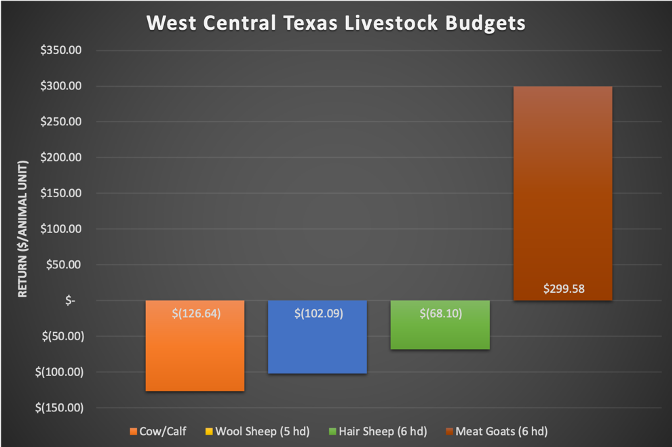
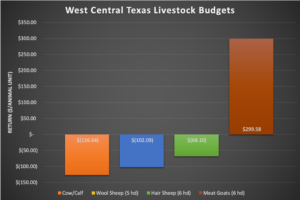
This begs the question “What amount of profit should a productive female generate annually?” While the answer is quite complicated and different for every farm or ranch, there is value in regional benchmarks and striving to meet or exceed these industry standards. The American Sheep Industry Association (ASI) provide an economic report that summarizes average profit per ewe by regions within the U.S. Below is a chart that shows the economic report for Texas and Southwestern sheep producers. The full report can be found at: https://c8e3i7k7.stackpathcdn.com/wp-content/uploads/2019/12/2018-ASI-Budget-Project.pdf

West Central Texas Livestock Budgets

Now you may be scratching your head and questioning how applicable this chart is to your operation. I too was shocked when I first looked at this report. After re-reading it line for line, hoping to fulfill my own bias that this must be wrong. I can say that this is actually very indicative of most commercial sheep operation in Texas. There are some assumptions made that have a significant impact of the budget, to which I encourage you to take a closer look at. For this article, I won’t dig into what all these assumptions are, but let’s just say that this report backs up a point I have tried to emphasize loud and clear; LAMB/KID CROP WEANED IS CRITICALLY IMPORTANT! A 25% increase in weaned can drastically improve gross sales.

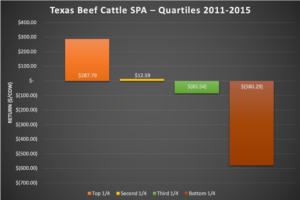
Texas A&M AgriLife Extension has a standardized performance analysis program for beef cattle producers. In this analysis, beef producers are broken into quartiles based on profit per cow from data collected from the ranchers themselves. The chart below shows the profit spread between the different quartiles. Interestingly, half of the Texas cattle raisers lose money and the bottom quartile lost twice as much money as the top quartile made. Details about this program can be found at: https://agecoext.tamu.edu/programs/management-programs/beef-cattle-standard-performance-analysis-spa/

Hopefully, this stimulated a bit of thought about two different subjects.
First, where do I fit? At present, we don’t have a centralized program for sheep and goat producers similar to the Beef Cattle SPA. I’d suggest you refer to the sheep economic budgets presented below and generate a report on flock returns per ewe for your operation. Are you above or below average?

Second, what profit potential exists for across the different livestock species? To address this, Bill Thompson, AgriLife Extension economist in San Angelo, has 2020 projected budgets for the different livestock common to West Central Texas. The chart below looks at return above fixed and variable costs. Details about these budgets can be found at: https://agecoext.tamu.edu/resources/crop-livestock-budgets/budgets-by-extension-district/district-7-west-central/2020-district-7-texas-crop-and-livestock-budgets/

Texas Beef Cattle SPA

If you raise meat goats, you are already planning to take this article to the local coffee shop to brag to your friends. If you don’t raise meat goats, you are either thinking about getting them or you are convinced that these economic reports are inaccurate. How can it be true that my operation isn’t profitable when I make a living on these animals? Before you disregard this information, I encourage you to look at these budgets closely; specifically review the implied weaning percentages, labor costs, and supplemental feed. Furthermore, when ranchers apply a value to fixed costs to pasture, livestock, and equipment, often they realize that these budgets are more accurate than they’d like to believe. Keep in mind that not all ranchers are businessmen (or women) and not all businessmen are ranchers, but those that have a boot in each world are the ones that thrive.

That is enough data for this month’s column. Even me, a self-certified data junky, needs to take time to reflect on this information. I plan to make time to review the information that I take to the tax office, quantify my true flock profitability, and make plans to improve this going into the future.

To provide feedback on this article or request topics for future articles, contact me at reid.redden@ag.tamu.edu or 325-657-7324. For general questions about sheep and goats, contact your local Texas A&M AgriLife Extension Service county office. If they can’t answer your question, they have access to someone who can.
Filed Under: Uncategorized

Reid’s Ram-blings: February 2020

February 4, 2020 by andyherring

Attract Youth to Livestock Production

In Texas, we don’t even have time to break our New Year’s resolutions before stock show season gets into full swing. My 10-year-old son is in his second year of showing lambs and we just finished up our county show. Although, baseball is still his number one priority, he has grown to appreciate his livestock projects. And I am growing to appreciate what his livestock project are doing for him.

Reid's son in the staging area with his lamb

In the staging area.

There are a few things that have changed quite a bit compared to 20 years ago when I was showing lambs. Lambs and goats are much bigger, and judges tend to like them a full body condition heavier than before. The quality and depth of competition is much stronger, which makes it more difficult to place very high at any of the major stock shows. The costs of purchasing and feeding competitive lambs and goats has also gone up. I never thought I’d see the day where I referred to a lamb as “only costing $500.”

Thankfully, the real benefits of these projects have remained the same. My son is learning important life lessons such as responsibility, general livestock care, and the value of hard work. During this process, I have had flashbacks of the time that I spent with my father and lessons that he taught me through showing lambs. I wouldn’t trade those moments for any monetary value.

My experiences in showing lambs created a passion for raising sheep and allowed me to build a bond with those who shared my interest, which forged a path that created who I am today. This is true of many youth who are involved in these livestock projects. I’d be willing to bet that a large percent of adults who have a career in agriculture, also showed animals in grade school.

But this does not mean that youth have to be involved in 4H or FFA livestock projects to develop a passion for animal agriculture. These projects require an enormous amount of time and energy that could be channeled into other efforts related to ranching.

As time has passed and the level of competition has increased, breeding of livestock show projects has taken some traits to an extreme. For the commercial producer, show lambs and goats (and most all show animals) have been bred too much for a specific look on a particular day, and not enough about performance under limited management indicative of larger scale production.

For instance, show herds may not be able to maintain adequate body condition common to Texas without a high level of supplementation. They may not rear an adequate number of lambs/kids compared to commercial genetics. These animals have not been bred for a high level of parasite resistance or resilience. Show sheep tend to not produce the best fleeces. To be honest, there is no perfect animal that can do it all. Animals bred to be superior for different traits are equally good in their own right.

Nonetheless, I feel that we now have two different industries. Show animals are bred to result in a particular appearance that the majority of judges will find pleasing to the eye. Granted these animals can have exceptionally good carcass value, but they may not be the most profitable genetics for commercial operations.

I bring this up because I personally struggled with this for years. When animals are evaluated in the showring, they are commented on their genetic superiority with terminology that is centered around livestock production. I took this to heart and for years, I could not see the value in commercial breeding animals that were good for their purpose but did not look like a show animal.

If we want to help our youth make the transition from success in the show ring to success in commercial ranching, we need to make sure that they understand that the best animals for different purposes are likely to not look the same. We also need to make sure that we are respectful to others that have animals that don’t look like ours.

Lamb with metrics

Ultimately, we are all raising food and fiber (and children). We are fortunate to have a customer for most all the products that we produce and a platform for teaching our kids about livestock and life. There is no need to talk negatively about another livestock producer because they don’t raise the type of animals you do.

There is a bright future for sheep and goat production in Texas, regardless of the type of animals each of us raise. Let’s keep developing young people that will continue the tradition of ranching to feed the world, protect rural communities, and care for the land.

To provide feedback on this article or request topics for future articles, contact me at reid.redden@ag.tamu.edu or 325-657-7324. For general questions about sheep and goats, contact your local Texas A&M AgriLife Extension Service county office. If they can’t answer your question, they have access to someone who can.
Filed Under: Uncategorized

  • Page 1
  • Page 2
  • Page 3
  • Page 4
  • Go to Next Page »

Subscribe

Delivered by FeedBurner

Recent Posts

  • Reid’s Ram-blings: March 2024
  • Reid’s Ram-blings: February 2024
  • Reid’s Ram-blings: January 2024
  • Reid’s Ram-blings: December 2023
  • Reid’s Ram-blings: September 2023
Texas A&M AgriLife Extension Service
Texas A&M University System Member
  • Compact with Texans
  • Privacy and Security
  • Accessibility Policy
  • State Link Policy
  • Statewide Search
  • Veterans Benefits
  • Military Families
  • Risk, Fraud & Misconduct Hotline
  • Texas Homeland Security
  • Texas Veteran's Portal
  • Equal Opportunity
  • Open Records/Public Information