• Skip to primary navigation
  • Skip to main content
  • Skip to primary sidebar
  • Texas A&M Forest Service
  • Texas A&M Veterinary Medical Diagnostics Laboratory
  • Texas A&M AgriLife Extension Service
  • Texas A&M AgriLife Research
  • Texas A&M College of Agrculture and Life Sciences
Sheep And Goats
Sheep And GoatsStaying Up-to-Date on Sheep and Goats
  • Menu
  • Welcome
  • Events
  • Blog

Reid’s Ram-blings: February 2022

February 4, 2022 by myra.marsh

Lifelong Learners

This edition of Reid’s Ram-blings was composed by Jake Thorne, Texas A&M AgriLife Program Specialist.

Sheep shearing school just wrapped up at the Texas A&M AgriLife Research Station in San Angelo this past month. Several Texans and even some out of state participants came together over the four-day course and learned the dance that is sheep shearing. Many of the students, even those who hadn’t ever picked up a handpiece before, were getting into the rhythm of long sweeping blows and harvesting full intact fleece by the final day, all in a timely manner that is as easy as possible on the sheep. With that said, learning to shear isn’t just something that happens. Registering for the course doesn’t guarantee you will be able to shear, and in fact, completing the course doesn’t even really make you a “shearer.” To be called a professional, you need several thousand repetitions and a constant desire to refine your technique. But back to the point of learning to shear, in all reality it is back breaking, physically intense, exhausting, and very frustrating. Almost everyone who has ever taken our course underestimates the challenge of learning to shear, mostly because they have seen someone who is quite good, make it look easy.
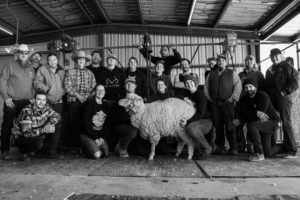
This concept of learning a new technique and then being asked to perform it in front of people is something we as adults struggle with, especially something physical. Most people who start out shearing are not very good at all, and being inadequate at something is bothersome to us, especially when others who are better than us are watching. Growing up, through school and sports, we are accustomed to learning and improving, and to some extent being judged on our abilities. As adults, we quickly forget how uncomfortable that is.

To be entirely honest, the vast majority of people who complete the sheep shearing school here do not go on to become professional shearers. Our original goal (and still main priority) of hosting this school was to supply the sheep and goat industries with shearers, however, I would venture to guess that maybe over half actually realize how hard of work it is and suddenly the cost of having someone come shear their animals seems quite worth it. Only a couple people every year take this skill and turn it into a service business, albeit a much needed one! With that said, everyone who goes through the course experiences personal growth that is truly amazing to see. Most start out enthusiastic, then quickly become defeated, then grith their teeth and persevere through the learning process and come out on the other end feeling accomplished. Some never make it past feeling defeated, as is the case whenever the challenge is hard.

As we start out another new year as member of the sheep and goat industry, I hope you make it a point to challenge yourself over the next year in a way that makes you uncomfortable, but ultimately more skilled and confident. You instantly become part of a small fraternity of others who have also learned said skill and you’ll find your network of friends and acquaintances expanding, even if that wasn’t the intent. As ranchers, we like to think of ourselves as being great problem solvers and accepting of challenges, but we are also prideful folk. Looking bad in front of other people is not our forte. It doesn’t have to be learning to shear a sheep, but really pushing yourself to learn or do something that you didn’t really think was ever possible will make us better in the end. They say moss doesn’t grow on a rolling stone, and while many think that is a statement about remaining physically active, I think it very much applies to our mental state as well. Lifelong learners usually live a long life.

Happy new year and I hope the dance lessons are worth it. Whatever dance that is.


To provide feedback on this article or request topics for future articles, contact me at reid.redden@ag.tamu.edu or 325-657-7324.  For general questions about sheep and goats, contact your local Texas A&M AgriLife Extension Service County office.  If they can’t answer your question, they have access to someone who can.
Filed Under: Uncategorized

Reid’s Ram-blings

January 10, 2022 by myra.marsh

2022 BHAGs

The new year provides us an opportunity to develop some goals for self-improvement.  Many of us set a goal to improve our physical, mental, or spiritual health.  But how often do you take time to develop some goals for the health of your farming and ranching business?

I’d encourage you to set some big hairy audacious goals (BHAG) for your sheep and goat operation.  The term BHAG comes from the 1994 book “Built to Last: Successful Habits of Visionary Companies” by Jim Collins and Jerry Porras.  BHAGs are meant to pull people out of a slump and energize them to implement a big picture-type plan that could take a longer time frame, like a decade, to complete.

The ranching community is mostly comprised of conservative people with very realistic expectations.  This gives us strength to endure hard times and protect the family ranching legacy.  However, it is a weakness, if we are trying to aspire to new heights and change the paradigm that your ranching operations has become accustomed to.

You must have been living under a rock this year, if you haven’t noticed a marked increase in the market value of sheep and goats of all shapes and sizes.  We all hope that these markets remain strong into the future and most indications are favorable to continuing this trend.  But let’s not become complacent by a high market. Why not use this as an opportunity to set a few BHAGs to increase the productivity of your flocks and herds?

Texas is blessed with a mild climate that is very suitable to raising sheep and goats without excess inputs, such as winter dry lot feeding or birthing our animals in shelters.  However, this blessing can also be a curse.  Texas generally raises one of the lowest lamb crops per breeding female compared to other states.  In my opinion, this is mostly a result of pasture-based management that increases the chance of predation, reduces our ability to prevent neonatal losses, and limits genetic selection for higher rates of fertility.

Don’t get me wrong, I’m not promoting that Texas add significantly more labor to raising sheep and goats.  But I am promoting producers to develop BHAGs that will increase your lamb and kid crop, with minimal changes to your overall management plan.

Obviously, predation is one of the greatest challenges that traditional sheep and goat ranches face.  We must continue to employ a variety of lethal and/or non-lethal strategies to minimize the impacts that predators have on our industry.  But we must not allow predation to limit what other management strategies we employ to increase the reproductive efficiency of our sheep and goats.

In my professional opinion, the simplest and most economical strategy to increase lamb and kid crop is to source rams, bucks, or billies from breeders that utilize NSIP to generate EBVs for reproduction and other traits.  Not only is this a proven scientific process but I have seen this technology make dramatic improvements in lamb crop of my own operation as well as others.  I must warn you that there are only a few breeders in Texas that have adopted this technology.  However, as the demand for these animals grows, I am confident that more seedstock breeders will use the technology and improve the genetic potential of the Texas sheep and goat industry. My own professional BHAG is to have 100 sheep flocks and goat herds from Texas enrolled in NSIP by 2030!

Next, I would suggest to pregnancy ultrasound your flock or herds, especially for those that birth in the pasture.  This allows for females that are not pregnant to be remove from the herd or lambing/kidding pasture.  It also allows manager to sort females into different pastures based on litter size, which has several advantages.  First, birthing the females in separate pastures allows for selection of replacements from more prolific dams.  It also allows for improved nutritional management of females that require more feed to raise larger lamb and kid crops.

These are just a couple management strategies that can result in you reaching your BHAG to improve lamb/kid crop.  We have helped develop 12 factsheets on this topic that can be accessed at http://lambresourcecenter.com.

Happy New Year’s and good luck as you work towards new heights with your ranching enterprise!

To provide feedback on this article or request topics for future articles, contact me at reid.redden@ag.tamu.edu or 325-657-7324.  For general questions about sheep and goats, contact your local Texas A&M AgriLife Extension Service county office.  If they can’t answer your question, they have access to someone who can.

Filed Under: Uncategorized

Reid’s Ram-blings: December 2021

December 3, 2021 by myra.marsh

Do You Podcast?

I am fortunate to hold a professional position where I am blessed with the opportunity to educate, prophesize, and/or ramble about industry-relevant topics. The details of what I share are based on a decade of higher education, followed by a decade of industry involvement. More recently, my daily routine hadn’t allowed for as much continuing education as I’d like, until I discovered podcasts.

About 2 years ago, we decided to produce a monthly podcast for the U.S. sheep industry.  This podcast is a collaborative effort of state extension specialists across the country and other leaders from ASI who also realized that jumping on the podcast bandwagon was a great way to spread awareness about happenings in the industry.  Our goal is to provide monthly interviews with researchers, educators, and allied industry on current topics relevant to sheep farmers and ranchers.

Currently the podcast “ASI Research Update” reaches between 500 and 1,000 listeners each month and continues to grow.  Erika Sanko, ASI Director of Analytics & Production Programs, coordinates this effort and Jake Thorne, Texas A&M AgriLife Sheep and Goat Program Specialist, serves as the host.

As an organizing member of this podcast effort, I’ve become a regular listener to a variety of other podcast channels as well.  This allows me to keep up with current sheep topics here in the U.S. and internationally.

We are all so busy these days that is hard for most of us to dedicate time for continuing education, either in front of a computer or in person at a meeting or event.  The fact that I can listen to podcasts in the car at my convenience really is ideal.  My phone syncs with my vehicle and these podcasts auto play with minimal effort or forethought.  I suggest researching channels that are of the most interest to you and subscribe. Don’t forget to go to your smart phone settings and allow notifications for new podcasts!

My favorite channels are listed below and hyperlinked.  I hope you find them as enjoyable, educational, and thought provoking as I do.


ASI Research Update

Sheep Stuff Ewe Should Know

Sheep Connect NSW (Australia)

Scene + Herd (New Zealand)

Now that I have included “learning” into my daily routine, my imagination has taken off as to what else I have been missing out on that can lead to a “better” me? Should I be shearing 10 sheep each morning for exercise? Or maybe racing my border collie on foot? Are there new lamb recipes that I haven’t heard of? Too much time to think however can really be dangerous for me. This is when I have to turn the dial back to the radio and allow music to calm my rambling mind.


To provide feedback on this article or request topics for future articles, contact me at reid.redden@ag.tamu.edu or 325-657-7324.  For general questions about sheep and goats, contact your local Texas A&M AgriLife Extension Service county office.  If they can’t answer your question, they have access to someone who can

Filed Under: Uncategorized

Reid’s Ram-blings: November 2021

November 1, 2021 by myra.marsh

Imports. Friend or Foe?

By now you know that I am a strong proponent of eating and promoting the consumption of lamb and goat meat. Bottom line, it is delicious, but the reasons to include lamb or goat in your meal rotation do not end there.  It is nutritious and versatile in the ways it can be prepared. And as producers I believe it is important for us to be advocates of our own products.

When we cook and eat lamb and goat ourselves, we also become better advocates for it.  I can’t count the number of times, I’ve heard “I only like lamb when Reid cooks it.”  Over time, the fear of something different and we gain another advocate.  Be Patient!

As a routine customer, I’m always inquiring about the origin of the product. Often, they are sourced from another country. Imported lamb is perceived by many consumers as exclusive and superior products.  In reality, most imported products are purchased by American restaurants or grocers because of price and availability.  Currently, domestic products are sold by wholesalers at roughly double the price of imported products.

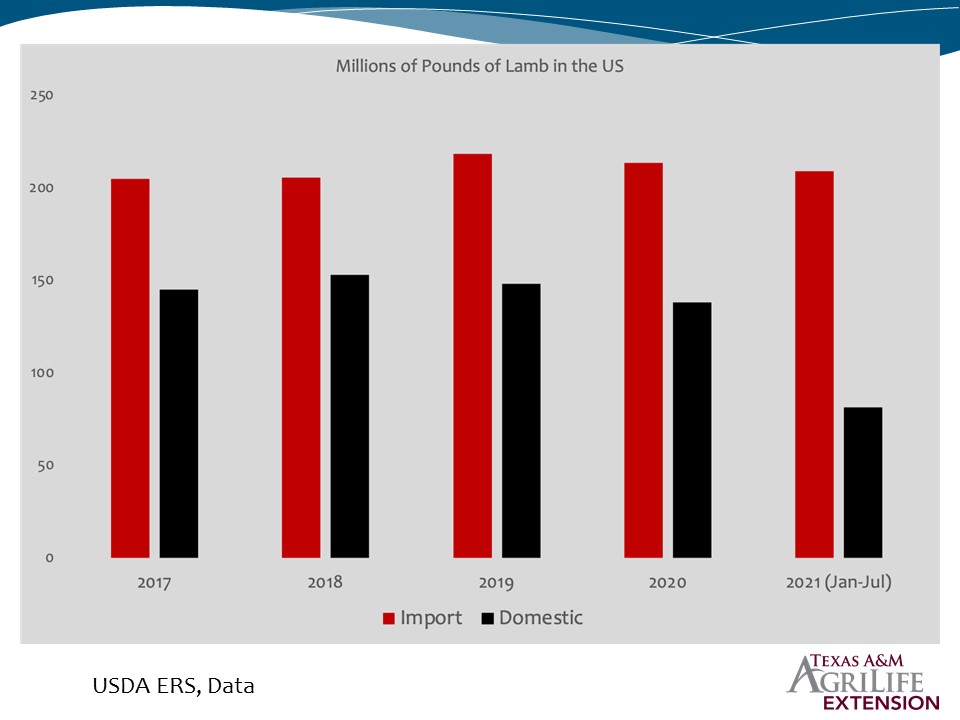
Over the last decade, half the lamb and a third of the goat meat consumed in the US are imported.  So far in 2021, lamb imports are nearly double US production (Figure 1). The top two countries that provide most of the lamb and goat meat are Australia and New Zealand, but that might be about to change.

In September of 2020, the Biden administration lifted a 30-year-old ban on British lamb and mutton from being imported into the US. The ban was originally created in response to the first outbreaks of BSE, commonly known as mad cow disease. With U.S. markets off the table until now, most of their exports were going to Europe. While it is unclear how this will affect American producers, one silver lining is that lifting of the ban also allows for the import of United Kingdom (UK) sheep genetics, such as semen and embryos.

The UK is the third largest exporter of sheep meats globally, behind Australia and New Zealand.  I had the privilege of touring the UK sheep industry in the fall of 2019.  During this tour, we learned that the British export roughly half of their lamb during peak production and import a similar equivalent of lamb from New Zealand during the off season. This “trade off” seems to work given that the UK and New Zealand have similar production systems but are located in different hemispheres.

I’d anticipate that British lamb will likely be marketed at similar value to other imported lamb products.  In theory, more supply will bring down lamb prices at the food counter and inevitably reduce value of lambs at the farm gate.  But I’ve come to realize that the US lamb market is complex and difficult to project.

The US lamb industry grossly undersupplies the demand and it is unlikely that we will grow to a level to meet this demand any time in the near future.  While I’d like to see our industry expand, it is more likely that we will see a further reduction in overall lamb and goat production.  Both from farmers exiting the industry and operations that reduce flock or herd size.  Furthermore, the rapidly growing non-traditional market prefers to harvest lambs at 25 to 50 percent lighter weights than conventional markets.  Harvesting lighter lambs results in even lower volume of domestic lamb production.  To keep a supply of lamb for the growing American appetite for lamb, we are likely going to need more imports.

In my opinion, the negative impact of imports are due to a discrepancy in value.  Imports tend to be cheaper for a variety of reasons.  First, emerging domestic demand has driven up the market for lambs and goats above global prices.  This is good for sheep farmers but it also creates opportunity for imports to gain a stronger foothold in traditional channels.  Second, the imports tend to have lower costs of production due to limited predation, access to more animal health products, economy of scale, government support programs, etc.

The goat market isn’t as affected by imports as they lack a sizable volume of goat meat for export.  Goat meat imports also come from Australia and New Zealand; however, their goats tend to be feral or very extensively managed.  Based on my impression, export demand has impacted their national herd size and further long-term exports appears to be unsustainable.  As an example, I have a friend in Australia that is proud to have successfully exterminated goats from their farm, as if they were pests.

In summary, the US lamb and goat industry is very much influenced by global trade. We need imported product to satisfy US demand and continue to grow the American appetite for lamb and goat meat.  However, imports have a competitive advantage due a lower cost of production than US sheep and goat producers.  I will be very interested to see how the markets react to future imports. What is still in our control though, is how we can be better advocates for lamb and goat meat. We’ll just have to take a page from Blue Bell’s playbook and “eat all we can and sell the rest.”

To provide feedback on this article or request topics for future articles, contact me at reid.redden@ag.tamu.edu or 325-657-7324.  For general questions about sheep and goats, contact your local Texas A&M AgriLife Extension Service county office.  If they can’t answer your question, they have access to someone who can.

Filed Under: Uncategorized

Reid’s Ram-blings: October 2021

October 6, 2021 by myra.marsh

Superior vs Optimal

There is the saying “Everything is Bigger in Texas.”  Texans are proud to have the largest populations of sheep and goats of any state in the union.  While the size of our sheep have been getting larger and larger over time, by no stretch of the imagination do we raise the biggest sheep in the US.  Sheep in the Midwest and Intermountain West tend to be much bigger.

The mild weather and diverse native rangelands of Texas makes this a great place to raise sheep and goats.  However, these range conditions tend to better support smaller-framed animals, but this puts us at odds with our general tendency to want bigger and better things.  I too am drawn towards selecting replacement rams and ewe lambs that standout in the crowd. But this strategy can have unintended consequences.

For years, we have used the term, “superior”, to define animals that we believe to be the best.  But as time progresses, I find the term, “optimal”, to better represent what ranchers see the most value in.  “Superior” makes the assumption that merit is defined by one universal set of rules; whereas, “optimal” suggests a balance of many traits that have been carefully curated for a particular environment or management style.

Texas sheep and goat operations are all unique.  They have different resources, strive to produce varying products, and construct different goals to measure success.   These differences outline the production traits that are optimal for each operation.

The performance of sheep and goats are a combination of genetic potential and management.  If an animal has the genetic potential to grow faster, grow more muscle, raise more offspring, or better fight off parasites, it still requires proper management to reach its potential.  There are no free lunches!

Field Day at HF4 Ranch: Advancing Genetics Technology in the Texas Sheep Industry

Moreover, many of these genetic attributes work against each other, especially when feed resources are limited.  For instance, an animal that grows faster and has a larger mature size may be less likely to raise multiple offspring or fight off internal parasites.  Can sheep and goats be genetically selected to do “all of the above”?  Maybe, but it takes a strategic approach fitted with the appropriate management.

If you are a long-time reader, you know that I am a strong proponent of estimated breeding values (EBVs).  These values provide a reliable prediction of many of the economically important traits to find the “optimal” genetics for each operation.  EBVs are a powerful tool to ensure data-driven selection and enable you as a producer to identify and select for your “optimal”  traits. Feel free to contact us to find out how to source animals with EBVs tailored to your operation.

An often-overlooked strategy to optimize sheep and goat productivity is crossbreeding. A common example of a successful crossbreeding strategy is to maintain a ewe flock of maternal, moderate framed females who are well adapted to the environment and range conditions, and then breeding these ewes to a ram that supplies the growth and muscle that we often get paid for at the sale. Not to mention, when the ewes and rams are different breeds, the resulting hybrid vigor is particularly advantageous regarding lamb survival and size. Using crossbreeding to outcompete purebred stock is as close to a “free lunch” as can be found in livestock production.  Historically, the use of black-face rams, typically Suffolk or Hampshire, on finewool ewes is the best example of this in Texas.  The cross-bred, smut or speckle faced, lambs would generally wean 10 to 15 lbs heavier and all lambs were sold.  Straight finewool rams were used on roughly half the ewes to generate replacement females.

Today, this practice is still somewhat common in finewool sheep but the use of terminal sires is not a common practice in the hair sheep industry. It is a viable strategy and needs to be considered more often.

Continuously breeding for animals that are always a little bit superior for a particular trait, without regard to the negative impacts this may be having in other areas has been an epidemic in livestock breeding since the beginning of time.

In summary, sheep flock or goat herd productivity can be optimized by selection of animals that have the desired traits fit for the environment they are raised in. EBVs are a great tool to source the right genetics; however, it is still best to source genetics produced in a similar production system.  Even greater levels of productivity can be realized if ranchers’ source maternal-oriented sires to raise replacements and terminal-oriented sires to produce offspring destined for harvest. Always remember, at the end of the day, optimal animals are those that work best for you and, your profit depends on your ability to identify your own “optimal” traits.


To provide feedback on this article or request topics for future articles, contact me at reid.redden@ag.tamu.edu or 325-657-7324.  For general questions about sheep and goats, contact your local Texas A&M AgriLife Extension Service county office.  If they can’t answer your question, they have access to someone who can.

Filed Under: Uncategorized

Reid’s Ram-blings: September 2021

September 10, 2021 by myra.marsh

Capitalizing on Opportunity

September is my favorite month of the year.  As a child, it marked the end of long, hot summer days and a return to school. Yes, I am one of those weird kids that looked forward to school.  The social aspect of school was a good break from the solitude of the ranch life.  And of course, the return of Friday night lights!  But, in truth, education is what I liked best.  Now as a parent of school age kids, I appreciate fall even more!

September represents a shift in production systems.  It is either the start of a new breeding season for winter and spring births or starts the fall lambing or kidding season.  The days are starting to shorten and cool down, which brings about a shift from warm season to cool season grasses and forbs.

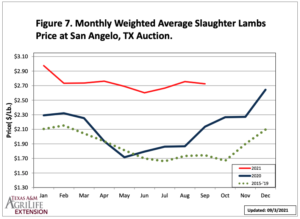
The fall also represents a shift in the overall market of sheep and goats.  The larger volumes of lambs and goats during the summer are starting to dwindle.  The reduction in supply starts to have positive impacts on market price.  While, this year has tended to follow the seasonal patterns, the base value of lambs and kids are high.  Historically, feeder and light weight slaughter lambs would have sold for less than $2 per pound and kid goats would have sold for less than $2.50 per pound.  This year the market averaged about 50% higher than normal.

There is no guarantee that the markets will remain high into the future but the factors that have driven up demand and limited supply aren’t likely to change in the near future.  So, how do sheep and goat producers take advantage of a good situation?  From my perspective, there are several options to consider.  First, grow lambs and kids to heavier weights. Second, shift breeding season to market lambs and kids in winter months. Third, improve flock/herd reproduction to market more lambs or kids.  There are other options as well, but for the save of space I will limit to these three for this article.

To help sheep and goat raisers project when, and at what weight, to market their lambs and kids, we have developed several marketing tools.  There are charts updated weekly on our webpage (sanangelo.tamu.edu) that are a summary of USDA AMS data from Producers in San Angelo.  They show a weighted average price for the current year, prior year, and five-year average before that.  These help to assess the market from a longer-term perspective, instead of weekly shifts.  We have also developed a prediction matrix for change in value of lambs and kids by month and weight range that is based on over ten years of data from the local auction reports.  This matrix was used to develop an iPhone app that conducts the calculations and displays them in charts.

A subject of common discussion among sheep and goat raisers is timing lambing or kidding to market offspring during the peak winter months or prior to an ethnic holiday.  While, this may seem very logical, it isn’t as easy as it may seem. We often see a reduction in the prolificacy of some sheep and goats during the spring because they are natural fall breeders. Also, there are undoubtedly costs associated with extra supplement needed by pregnant females during the winter, but ranchers make money on margins and while inputs may be increased, the potential value of a fall lamb or kid crop could more than make up for this.

Seasonal Pattern of Lamb Market by Month


Improving a lamb or kid crop is one of the greatest challenges for a sheep or goat rancher to accomplish because of the need to maintain good nutrition, thwart predators, prevent disease, and adapt to what mother nature provides.  Sheep and goat folks take great pride in their animals and will do most anything to keep them healthy and productive.  But I’d like to challenge you to raise the bar for what you’d consider a good lamb or kid crop.  Measure your success or failure and document this in a place that is easy to find and remind yourself.  Do this not only for your betterment but for the opportunity that this provides the next generation on the family ranch.

It is my professional opinion that most of our Texas flocks and herds lack the genetic potential to seize the opportunity that lies ahead of us.  In essence, ~ 120 percent lamb or kid crop might be the best we can do, whereas small ruminants with an improved reproductive genetic potential could have raised a 50 percent larger lamb or kid crop.

Selection for higher reproductive potential is possible, but, it won’t happen overnight. Lamb or kid crop is multifaceted set of traits and many of these traits are low to moderately heritable. Unlike, wool or growth traits that tend to be moderate to highly heritable and negatively correlated with reproduction.  There is a high probability that we have selected against reproductive fitness due to over emphasis on wool, growth, and carcass traits.

To make real and measurable increases in lamb and kid crop, I feel strongly that we need to do a better job in selection of replacements for a higher reproductive potential.  The best prediction tools on the market for genetic potential are EBVs (estimated breeding values) from flocks or herds in the National Sheep Improvement Program (NSIP).   Most commercial operations won’t have the time and resources to generate EBVs on their own sheep/goats, but rather they can source rams or billies with above average EBVs for the reproductive traits.  Keep in mind that rams or billies won’t increase the lambing or kidding rate of the flock or herd until their daughters are raising offspring.  It is a long-term investment.

This fall is looking like the start of another fantastic opportunity to market lambs and kids for high value. Capitalizing on these opportunities are the types of decisions that help keep businesses alive and ranches in families for generations.  Let’s try and seize the opportunity for the next generation to have a brighter future than our own. If AgriLife Extension can be of assistance, don’t hesitate to contact us.

To provide feedback on this article or request topics for future articles, contact me at reid.redden@ag.tamu.edu or 325-657-7324.  For general questions about sheep and goats, contact your local Texas A&M AgriLife Extension Service county office.  If they can’t answer your question, they have access to someone who can.

Filed Under: Uncategorized

Reid’s Ram-blings: August 2021

August 3, 2021 by myra.marsh

Preserving the Legacy of Texas Ranching

This edition of Reid’s Ram-blings was composed by Jake Thorne, Texas A&M AgriLife Program Specialist. 

“Our kids are our future.” This quote, or some version of it, is universally accepted as truth. I expect that most readers of this article agree that raising children in the world of production agriculture is unparalleled. Kids thrive when there is space to get dirty, creeks to be played in, animals to feed, and responsibilities to be learned the “old-fashioned” way. Even with the afore mentioned benefits, why is it that children who become young, working adults are not all returning “home” to the ranch/business?

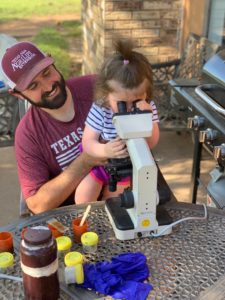
Never too young to learn to check for parasite load

The sheep and goat industries are certainly not immune to this generational exodus. One only needs to look at the decline of total sheep and producers over the last half century to realize that it has contracted significantly, and at least some of that contraction is due to an imbalance between number of parents or grandparents exiting the business and number of young adults entering it. How do we, as an industry, change this?

The reality is the small ruminant industries of Texas have a problem with succession, and the solution is about as clear as a stock tank after a summer rain. In our jobs as Extension professionals, we try to only stick to scientific fact, which is why we often default to discussing topics such as animal health and management, etc. I write this article today with intentions less focused on providing the latest information and more as a gentle nudge of thought provocation. To ensure a strong future for the sheep and goat industries, we need the next generation to take over the family business, and we need young people not raised in this particular agriculture sector to enter it.

If you are a rancher and you have kids, it is never too early to have “the talk” with them. Not “the birds and bees” talk, I mean “the ranch talk”. The one that opens up a clear line of communication about succession planning. Kids are starting to think about jobs and their futures as adults way earlier than you realize, and they need to know if and when there may be a spot for them in the family ranching business. The “how, what, and who” of this discussion is entirely up to you and your family, but all I ask is that the discussion is had.

There are a number of great resources out there, a simple google search will provide a number of guides on this form of planning, if you need somewhere to start. Thinking about retiring/passing-the-reins/selling-out/moving to town (yikes!)/succession planning is way outside the comfort zone of most ranchers I know, and too often the topic is avoided. Families that have not had the discussion on how to incorporate the younger generation into the business early on almost always pay for it dearly in the end, and too often this leads to one more operation that is lost.

The second reality about succession planning is that some kids do not want to take over the family ranching business. The knee-jerk comment is always “well kids these days don’t want to work,” but that is not always the truth. Young people are learning to work, just differently than their parents (getting into this too much would turn this into a novel).

The hard question that ranchers need to sometimes ask themselves is, have I built a business that my kids want to take over? Is this business truly profitable? Is what I see as a labor of love being perceived as just non-stop back-breaking work to my children? Is that a lifestyle they want? Is that really what I wanted when I was young? These are tough self-reflecting questions. Again, every situation and every family is different, but avoiding these discussions is most certainly not the right way to go.

Finally, if your family is not in a situation to pass the business or ranch to a child, I would encourage you to entertain other ways to assist the future generation of Texas sheep and goat producers. In fact, there are many young people who would like to enter into livestock production, but do not have family land. The startup capital needed to get established in ranching is almost always cost prohibitive. If you, as an established rancher, have the capability to partner with or offer lease land to a young producer, know this could be life-changing for them. Maybe this lessee will bridge the gap until the next generation in your family is ready.  Allowing someone else to ranch on your ancestral place is nearly always a sacrifice. Nevertheless, you may be surprised by the fulfillment that comes with this act of selflessness.

It would be completely unfair for me to write an article about succession planning and encouraging ranchers to ask themselves tough questions without saying thank you all you have done to ensure that the Texas Sheep and Goat industries are as strong as they are today. Through maintaining traditions and teaching invaluable life lessons that can only be learned in the working pens after a long day of marking lambs, you, as producers, have shown the younger generation “the way.”

Hopefully, you can maintain this legacy for your kids and for generations to come. Communication, something that might not come easy to most of us, may just be the missing piece to ensuring that your family’s business and way of life is preserved. The Texas sheep and goat industries are full of the best people in the world; those that do not back down from a challenge to do what’s right. Sometimes, those challenges are just a simple discussion around the family dinner table. Here’s to a strong future for the next generation of Texas sheep and goat producers!


To provide feedback on this article or request topics for future articles, contact me at reid.redden@ag.tamu.edu or 325-657-7324.  For general questions about sheep and goats, contact your local Texas A&M AgriLife Extension Service County office.  If they can’t answer your question, they have access to someone who can.

Filed Under: Uncategorized

Reid’s Ramb-lings: July 2021

July 2, 2021 by myra.marsh

To Drench, or Not Drench

This spring was cooler than most and some were fortunate to get a good healthy rain.  As things start to warm up, we expect to have problems with internal parasites in sheep and goats.  Fortunately, there has been some advancements in technology to help in the fight against these pesky parasites.  The bad news is, strategic treatment is not simple, and the more science learns about parasites, the more we realize just how much we don’t understand!

For me, the complexity of life is part fascinating and part frustrating. The intricate process by which sunlight and water grow plants that are eaten by sheep and goats to sustain themselves, grow, and reproduce is truly incredible. It is amazing how they overcome challenges and thrive in the face of adversity. Unfortunately, parasites, predators, and pathogens that negatively impact sheep and goats are just as complex and resilient.

Therein lies the dilemma: how we make decisions to better manage sheep and goats knowing there will always be drawbacks to every decision.  Successful ranchers employ practices that result in the most benefit with the fewest consequences.  Yet, best practices differ from one operation to the next and these best practices are constantly changing.  The reason they vary between operation is because each ranch has different resources (labor, land, feed) and different overall management strategies (breed, season of birth, supplementation).

Parasite management is the best example of this.  The barber pole worm (H. contortus) is the most damaging parasite to sheep and goats and is particularly problematic for certain animals: those that are thin, lactating, or young. Though the barber pole worm thrives in wet, warm, late spring conditions, it can still persist in most any animal and in any weather condition common in Texas.

For decades, ranchers administered dewormer products repeatedly to prevent barber pole worm. However, treatment does not always eliminate every worm from the animal, with some resistant specimens surviving. These worms then reproduce at an alarmingly fast rate (10,000 eggs per day!) and before you know it, an entire population of worms resistant to the treatment you utilized has developed. Continuing to treat animals with the same products and tactics is eventually useless. Slowing the rate of dewormer resistance is possible, but requires an understanding of the parasite, its lifecycle, and the animal’s immune system.

Simply put, there is no silver bullet to control parasites that will work for everyone.  If someone tells you otherwise, they are misled, misinformed or straight up lying.  Strategic parasite management is a plausible solution, but this requires implementation of several strategies to mitigate the impact of internal parasites.

Parasite Management Practices Common to Texas Sheep and Goat Industry:

  • Fall or Winter Lambing/Kidding: Animals with compromised immune systems are most susceptible to barber pole worm. By shifting the birthing season to a time when parasites are not thriving because of less-than-ideal environmental conditions (for them, at least) your livestock may be vulnerable, but the threat of parasites is not nearly as high.
  • Combination Treatments: Providing 2 or more dewormer products back-to-back improves the efficacy of treatment and prolongs development of resistance. Copper oxide wire particles may be part of the combination treatment.
  • Refugia: The process of leaving some animals untreated, while treating those who are in need, is called refugia, and allows for not at-risk animals to harbor parasites that aren’t resistant to the combination treatment. Eliminating barber pole from your herd/flock completely is not realistic, so if you are always going to have parasites in your sheep or goats, at least they are worms that can be sufficiently controlled with anthelmintics.
  • Genetic Selection: Some sheep and goats are more susceptible to barber pole worm than others; identifying and keeping those that have greater resistance as breeding stock can be a major piece of the puzzle. In brief, certain aspects of some animal’s immune systems allow them to naturally prevent parasites from becoming overly established in their abomasum. Fecal egg counting is a common way to estimate worm loads and a great tool for identifying potentially resistant animals. To help ranchers test their animals for parasite resistance, we have started a fecal egg count laboratory. Check out our website for more information.
  • Grazing Management: Barber pole worm hatch and develop outside of the animal, but are consumed when the animal grazes short grasses that the larva has crawled up on. The period from hatch to consumption by the animal can be as short as 4-5 days in ideal parasite conditions. Rotation of pastures before the parasites have developed is a great tool, however it requires the rancher to be set up for such. When grasses are taller (above 4-6”) or weather conditions are not suitable for egg hatching, having a longer rotation interval is OK. The key is, larva can survive on pasture for months, so not re-grazing the same area for a while is important for pasture rotation practices to be effective.

Employing a number of these practices on your ranch can help reduce both the economic and animal health related consequences brought on by internal parasites. Philosophically, it seems the “best” ranchers manage their land and livestock to maximize profit in good years and limit losses in poor years. Not to mention, they are lifelong learners who know that they have nothing completely figured out and relish the chance to incorporate new ideas and techniques. This spring has west Texas set up for a good grass growing season and livestock and their young should flourish… don’t let internal parasites ruin this opportunity!


To provide feedback on this article or request topics for future articles, contact me at reid.redden@ag.tamu.edu or 325-657-7324.  For general questions about sheep and goats, contact your local Texas A&M AgriLife Extension Service county office.  If they can’t answer your question, they have access to someone who can.
Filed Under: Uncategorized

Reid’s Ram-blings: June 2020

June 3, 2021 by myra.marsh

Half of What You See

My high school ag teacher used to say, “Believe nothing that you hear, and only half of what you see.”  At that time in my life, I took the statement as comical and sarcastic.  We must have faith that people aren’t constantly lying to us.  And what we see with our own eyes must be true. Right?

As much as I wanted to discount this bold statement, it has stuck with me for several decades.  The primary reason it didn’t become a distant memory is I was constantly reminded of it each time I learn something new that contradicted something that I previously thought to be fact.  After a decade of higher education and constant reminders of how wrong I was, I learned to not place “absolute faith” in something someone says or something that I saw.

The truth is complicated and there are very few absolutes in life. We must always keep an open mind, or we will be blindfolded to learning.

One of the most difficult “false truths” that I have had to overcome has been assessing genetic merit of sheep.  As an active participant in 4H and FFA market lamb projects, we strived to raise the best show lambs that we possibly could.  The rules of the game were fairly simple.  Work hard to raise or purchase the best lambs we were capable of.  Feed, exercise, and train our animals to show.  Exhibit your projects to a judge and hope for the best.

I believed “absolutely” that livestock judges were quantifying the value of “all” sheep.  And it took nearly a decade of industry involvement beyond my youth livestock experience to admit I was wrong.  The market lamb projects were about making me a better person and exposing me to agriculture.  Genetic value of livestock is determined by the animal’s potential to produce a desired product within the environment they are being raised.  Desired product and environment vary widely across the sheep and goat industry.

Desired Product: In Texas alone, sheep and goat producers strive to create a wide array of products which have evolved over time.  At the peak of sheep and goat production in the 1950s, the largest majority of producers focused on producing high value wool and mohair.    Fiber quality and fleece weight were top priorities for selecting replacements.  As the animal fiber market diminished over several decades, some ranchers transitioned to selection of larger and faster growing animals to increase revenue from lamb and goat sales.  Other ranchers transitioned to animals that would perform well in the showring and marketed high value show stock. More recently, the majority of Texas ranchers have transitioned away from fiber production all together.  Today, Texas has a diverse sheep and goat industry that serves a diverse consumer base that want different things.  This diversity has proven to be very resilient during turbulent times.

Environmental Fitness:  This term is used often by geneticists to describe how well an animal is likely to perform on a particular ranch based on location and style of management.   For instance, Central and East Texas have a much higher parasite burden than West Texas.  Sheep and goats that have been selected for parasite resistance are essential to most pasture-based ranchers in higher rainfall areas.  Yet, these same animals may not perform as well as others in an environment that has a low internal parasite burden.  Mature body size, seasonality of breeding, reproductive potential, and grazing behavior are just a few other traits that can affect how well a sheep or goat is fit for the environment. As I stated before, it is complicated.

Yes, genetic potential is important.  But if you are buying genetics that others define as ideal, there are some important considerations you need to make to determine if these animals are also ideal for you. Take in to account their management style, their production goals, and their consumer base. Do these match with yours? No two operations are exactly alike, and if you cannot justify a purchase based off these points, buyer’s remorse may be a likely outcome!

My point of all this rambling is urge you to think deeply about what type of animals you want to raise and how you want to raise them.  Don’t let someone else’s strong opinions overtake your own common sense.  Sheep and goat ranching is complicated.  To sustain a sheep and goat operation, you must utilize your ranch resources effectively and employ a management style that fits your goals.  When your genetics and management align, your life will be much easier (and your pockets deeper!).

My ag teacher was right!  What others value in an animal may not be important to you at all. And only half of what you see in an animal is genetic. In-depth discussions for how to best measure genetics are best saved for another day, but in brief; an understanding of how the animals were raised and accurate performance records are the foundation to making sound decisions.


To provide feedback on this article or request topics for future articles, contact me at reid.redden@ag.tamu.edu or 325-657-7324.  For general questions about sheep and goats, contact your local Texas A&M AgriLife Extension Service county office.  If they can’t answer your question, they have access to someone who can.
Filed Under: Uncategorized

Reid’s Ramb-lings: May 2021

May 3, 2021 by myra.marsh

Ranching Solutions

While the new year officially starts in the winter, spring kicks off so many new things on farms and ranches.  Lambs and kid goats are frolicking around in green pastures.  The weather tends to be quite pleasant.  Moisture tends to go further and there is much optimism in the air.  And, of course, it is baseball season!

Besides my role as little league coach, this spring has also brought on quite a few new opportunities for me and the Texas A&M AgriLife Research and Extension Center in San Angelo.  I’m honored to have been named the director of the research center, while still retaining much of my duties as a sheep and goat AgriLife Extension specialist.  It is my goal to uphold the reputation built by people before me and help the center break new ground to benefit the agriculture producers of Texas.

The center’s mission statement is simply “Ranching Solutions.”  But solving issues faced by agriculture producers in this region are by no means simple.  Many of these issues have been around for decades and there is no silver bullet to fix them.  We must continue to find strategies to mitigate their impact, be adaptive to a changing world, and always be prepared to handle new problems that may be on the horizon.  This mindset by previous center directors has helped build the reputation of our institution as one of the leading sheep and goat research entities in the U.S.

While the population of sheep and goats isn’t what it once was here, West Central Texas is still the largest producer of lamb and goat in the U.S.  Fortunately for me, as a sheep and goat guy, and fortunately for other sheep and goat enthusiasts, the market has been steadily improving year by year.  Now that the average lamb and meat goat live prices are $3 and $4.50 per pound (local auction market as of mid-April), there is no doubt that small ruminants are a wise investment for farmers and ranchers of this region of Texas.

I fully intend to urge our team of scientists and extension professionals to continue research and outreach efforts to benefit small ruminant producers.  Yet I appreciate that things are always changing, and there is a need to remain adaptive to these changes.  Therefore, we will continue to seek opportunities to improve the lives of Texans whatever the opportunity may be.

The Texas A&M AgriLife agency is funded by and called to serve Texans.  I not only welcome but encourage input from stakeholders of this region.  Often, research issues and outreach ideas come from the farmers and ranchers who deal with agricultural challenges daily.  In many cases, we can develop partnerships to help resolve these issues.  A few of these recent successful collaborations include the Texas A&M AgriLife Livestock Guardian Dog program, in partnership with the Texas Sheep and Goat Predator Board, and the market reports on our website and the Lamb and Goat Market Forecast iPhone app, which are both the result of a partnership with Producers Livestock Auction Company.

One of Babe Ruth’s most famous quotes is “Never let the fear of striking out keep you from playing the game.” While we can’t strike out each and every issue that you may be facing, Texas A&M AgriLife will always continue the pursuit of improving the agriculture industry. Communication with you is vital to this pursuit and we hope to hear from you on how we can better the lives of Texans.


To provide feedback on this article or request topics for future articles, contact me at reid.redden@ag.tamu.edu or 325-657-7324.  For general questions about sheep and goats, contact your local Texas A&M AgriLife Extension Service county office.  If they can’t answer your question, they have access to someone who can.
Filed Under: Uncategorized

  • Page 1
  • Page 2
  • Go to Next Page »

Subscribe

Enter your email address:

Delivered by FeedBurner

Recent Posts

  • Reid’s Ram-blings: March 2024
  • Reid’s Ram-blings: February 2024
  • Reid’s Ram-blings: January 2024
  • Reid’s Ram-blings: December 2023
  • Reid’s Ram-blings: September 2023
Texas A&M AgriLife Extension Service
Texas A&M University System Member
  • Compact with Texans
  • Privacy and Security
  • Accessibility Policy
  • State Link Policy
  • Statewide Search
  • Veterans Benefits
  • Military Families
  • Risk, Fraud & Misconduct Hotline
  • Texas Homeland Security
  • Texas Veteran's Portal
  • Equal Opportunity
  • Open Records/Public Information